Executive Summary
- The “Agentic” Shift: Salesforce has pivoted from a human-led CRM to an “Agentic Enterprise.” It moved its core clouds under Agentforce names in October 2025, then restored familiar names such as Sales Cloud and Service Cloud in September 2026, with Agentforce and Data 360 as the AI and data layers driving business operations.
- Proven Scale & ROI: Adoption has accelerated rapidly, with over 18,500 Agentforce deals closed by late 2025. Early adopters are reporting massive efficiency gains, including a 99% reduction in reporting times and 72% automation in high-volume inquiry sectors.
- Data as the “Brain”: The evolution of Data 360 (managing 50 trillion records) and the introduction of Clean Rooms provide the secure, unified foundation required for autonomous agents to operate without hallucinations, specifically in regulated ANZ sectors like Finance and Education.
- Workforce Evolution: The role of the Salesforce professional is shifting from administrator to “AI Orchestrator,” focusing on data governance and agentic logic. This has resulted in a premium for Architects, with top-tier salaries reaching $234,000 AUD.
Introduction
For over twenty years, the “Cloud” was the north star of enterprise technology. At TechForce Services, we’ve spent a decade helping organisations migrate to the cloud to find agility and scale. But as we move through 2025, it’s clear that the cloud is no longer the destination – it’s the foundation.
The tech world accelerated in 2025, but Salesforce hit warp speed with its seismic shift to an “Agentic Enterprise.” We are currently witnessing a “hard pivot” where the human-led CRM era has been retired; in its place, autonomous AI agents via Agentforce collaborate with teams to deliver business outcomes.
This agentic AI evolution isn’t just a rebranding exercise; it’s a fundamental shift in how businesses operate. At Dreamforce 2025, Salesforce moved its core products under Agentforce branding, and in September 2026 it restored the “Cloud” names while keeping Agentforce as the AI layer across them.
The "Marketecture" Shift: Why the Name Change Matters
The temporary removal of “Cloud” from Salesforce’s core product names in October 2025 signalled that AI agents had become primary drivers of the platform. Restoring those names in September 2026 confirmed that the clouds remain the foundation the agents work on.
Through both renames, the products themselves stayed the same: Sales Cloud, Service Cloud and the industry clouds remain the technical engines of the suite.
The pivot is architectural: applications like Sales Cloud and Service Cloud haven’t disappeared; they have been repositioned as the data and logic layers now being “driven” by Agentforce to perform autonomous work.
Product Name (Original) | Rebranded Name (October 2025) | Current Name (Since September 2026) |
Sales Cloud | Agentforce Sales | Sales Cloud |
Service Cloud | Agentforce Service | Service Cloud |
Data Cloud | Data 360 | Data 360 |
Marketing Cloud | Agentforce Marketing | Marketing Cloud |
Education Cloud | Agentforce Education | Education Cloud |
Financial Services Cloud | Agentforce Financial Services | Financial Services Cloud |
Banking and insurance firms are using Financial Services Cloud with Agentforce for proactive fraud detection and conversational banking. By grounding AI in deep industry data, institutions are resolving 99% of compliance issues automatically and speeding up claims processing by 60%.
Technology Milestones: Scaling Digital Labor
By late 2025, the results of the evolution of agentic AI are undeniable for early adopters. The transition from “experimenting with AI” to “deploying agents” has hit several key milestones:
- Massive Adoption & ROI: Salesforce reported closing over 18,500 Agentforce deals by late 2025 (with 9,500+ being paid deals), a massive jump from 5,000 in early FY25. Organisations are using these tools to accelerate business automation with AI, seeing returns such as a 99% reduction in reporting time (from 15 days to 35 minutes) and a dramatic drop in operational costs per report.
- Vibe Building via Agentforce Builder: The development of AI agents has been democratised. Business users can now use natural language to “vibe build”—describing an agent’s intent to have the platform generate the digital labor required to execute it instantly.
- Data 360 & Clean Rooms: Reaching a milestone of 50 trillion records, Data 360 serves as the unified “brain.” For Australian organisations, the introduction of Clean Rooms is a game-changer, allowing for secure data collaboration between partners (like universities or banks) without ever exposing sensitive PII.
- Outcome-Based Pricing: Salesforce’s shift to usage-based pricing aligns your investment directly with value. Instead of paying for “seats” that might go unused, businesses now pay for successful outcomes and “work” performed by agents.
Industry Spotlight: Transforming ANZ Education & Finance
In the Australian and New Zealand markets, two sectors are leading the charge into the future of AI agents:
1. Higher Education
Universities are moving from “broadcasting to conversing.” Instead of mass emails, Agentforce for Education provides 24/7 student support. Sydney University pilots have shown that agents can manage student onboarding and tutoring inquiries with a 72% automation rate, allowing staff to focus on high-risk student interventions.
2. Financial Services
Banking and insurance firms are using Financial Services Cloud with Agentforce for proactive fraud detection and conversational banking. By grounding AI in deep industry data, institutions are resolving 99% of compliance issues automatically and speeding up claims processing by 60%.
Career Shifts: The Rise of the AI Orchestrator
The 2025 pivot is fundamentally reshaping the workforce. Routine administrative tasks—data cleanup, record updates, and basic reporting—are being automated. This allows Salesforce professionals to move into the role of the AI Orchestrator: experts who focus on data governance, ethical AI design, and agentic process logic.
While global developer demand dipped by 12% due to the rise of AI-assisted coding (Claude/ChatGPT), the demand for Architects who can design complex, multi-agent ecosystems is at an all-time high.
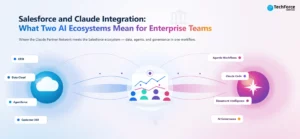
To see how these multi-model environments operate across enterprise platforms, explore our perspective on Salesforce and Claude integration for enterprise teams.
My Take: Partner for the Agentforce Edge
Salesforce has set a bold target of $60B+ in revenue by 2030, driven by a return to double-digit organic growth. With a market cap holding strong at $248.55 billion, the company is proving that the “Agentic Enterprise” is the most viable path to profitable growth in the agentic era.
Your Salesforce clouds are now the foundation your AI agents work on. TechForce Services connects your existing clouds to agentic workflows, using Data 360 and helping your teams become AI Orchestrators, so Salesforce moves from record-keeper to revenue engine.
The Agentforce era is here. Ignore it, risk obsolescence. Lead it—starting today.
Your Use Case + Our Skills = Agentified Salesforce = Massive Revenue Wins.