Overview
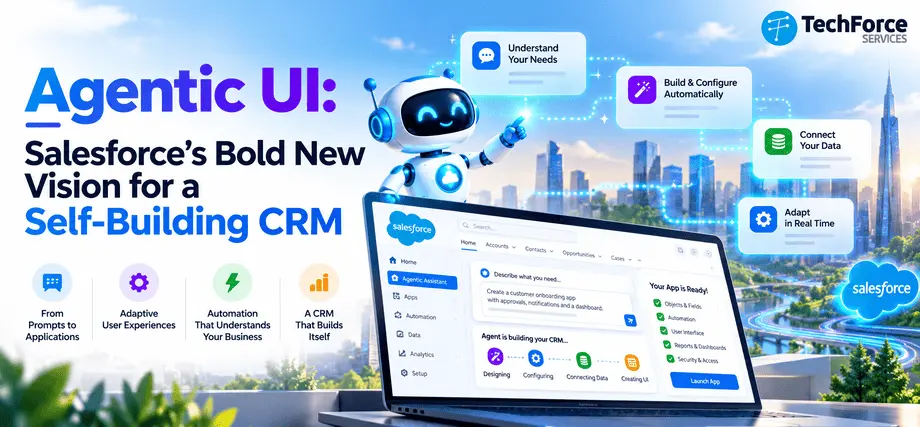
- Agentic UI is Salesforce’s shift from fixed page layouts to interfaces that an agent assembles in real time, based on the task at hand.
- It is powered by the Headless Experience Layer (HXL), which is already rolling out, so the same logic can appear inside Slack, a mobile app, or a conversational assistant without separate builds.
- Clean architecture and disciplined field-level security are now prerequisites, not nice-to-haves, before an agent can safely act on a user’s behalf.
- Admins, architects, and consultants all need structured training on the new agent-building tools well before this reaches general availability.
Salesforce just told the industry something big: the interface as we know it is going away.
At Dreamforce 2026, the company unveiled AIforce, a trusted enterprise layer that brings Salesforce data, workflows, and permissions to any AI agent or interface. It is the clearest example yet of what is increasingly called Agentic UI — screens that build and rearrange themselves around what a user needs to do, not what a designer assumed they would click months earlier.
This article unpacks what Agentic UI actually means, why enterprises are moving so fast on it, and what your team needs to have in place before it lands inside your own org.
If you have spent the last few years standardizing on Lightning page layouts, this is the moment to start planning for the next architectural shift, not after Agentic UI has already reached general availability.
What Is Agentic UI?
In simple terms, it is not a redesigned dashboard or a new coat of paint on existing screens. It is a dynamic layer that generates the interface in real time, based on a user’s role, intent, and the task sitting in front of them right now.
Instead of navigating fixed tabs and rigid page layouts, an employee simply tells an agent what they need, and the system assembles the right fields, records, and next actions on the spot, without a developer pre-building that exact screen.
This only became possible because of years of quiet progress in artificial intelligence agents that can reason about context instead of just executing a fixed script line by line.
Salesforce’s Agentforce platform, and its Atlas Reasoning Engine do that reasoning behind the scenes, and that is what makes this feel less like automation and more like a genuine assistant.
Why Enterprises Are Embracing This Shift
Enterprises are not chasing this trend for novelty’s sake. Static interfaces force every user, regardless of seniority or role, into the same rigid workflow, and that mismatch quietly costs real time every single day.
Agentic AI UI design flips that model on its head, so the software adapts itself to the person using it; Salesforce’s own product overview positions the Headless Experience Layer as core platform architecture, not a side experiment.
Inside Salesforce's New Interface Model
Technically, this runs on what Salesforce calls the Headless Experience Layer: a metadata-driven system that separates the underlying business logic from whatever “surface” ends up displaying it, whether that surface is Slack, a mobile app, a browser tab, or a conversational assistant.
Salesforce’s official developer documentation describes a build-once, deploy-everywhere model: you define the interface once, and Slack, Agentforce, Claude, or any MCP-compatible host renders it natively. Every surface becomes interchangeable, because the very same task can be completed inside a chat window or a traditional record page.
The intelligence itself lives in the metadata layer, not in any single screen, which is a meaningfully different architecture than the page-layout model Salesforce admins have worked with for two decades. It is an elegant answer to a problem admins have quietly complained about for years: rebuilding the same business logic separately across every single channel a customer or employee might use.
Where This Fits Across the Salesforce Ecosystem
Agentic UI does not live in isolation. AIforce launched with three components: Claudeforce, which brings Salesforce into Claude; Slackforce, which brings Salesforce context into Slack; and Agentforce Coworker, an AI teammate inside Lightning.
Together, they let the same underlying intelligence surface in a Slack channel, a Claude conversation, or a native Salesforce record with no duplicated build work. We cover each one in our Dreamforce 2026 keynote recap.
For consultants, that matters because a single configuration decision made today could determine how consistently an agent behaves across three or four different surfaces a year from now.
It also raises a governance question the original keynote only touched on briefly: if the same agent can act inside Slack and inside a customer-facing app, field-level security and permission sets have to be airtight everywhere at once, not just on the surface your team happens to be testing in.
The Technical Backbone: Frameworks and Architecture
None of this works without solid groundwork underneath it. The agentic AI frameworks powering these experiences depend heavily on clean data models, well-governed sharing rules, and metadata that is actually maintained on an ongoing basis, rather than bolted on once and forgotten.
This is exactly where SFDC architecture decisions made years ago start to matter again in a very real way. Orgs carrying tangled custom objects and inconsistent field-level security will feel this transition far harder than orgs with disciplined, well-documented data governance already in place.
It is also why the role of a Salesforce solution architect is becoming more strategic rather than less important, because someone still has to design the guardrails that let an agent act autonomously without ever exposing data it should not be able to touch in the first place.
What This Means for Your Team
For admins and consultants, this is as much a skills shift as it is a technology shift. Teams that have only ever configured static page layouts and simple flows will need genuine, hands-on training on Salesforce’s newer agent-building and metadata tooling to stay relevant over the next two or three years.
That is not optional reading for a slow afternoon; it is the real difference between shaping this rollout on your own terms and reacting to it after competitors have already moved.

Getting Ready for the Agentic UI Era
Agentic UI is no longer a distant concept. Agentforce Coworker is available now, and Salesforce in Claude and the Headless Experience Layer are already rolling out, so organizations that treat it as next year’s problem will likely spend all of 2027 catching up instead of getting ahead.
The right move today is auditing your existing data model, tightening field-level security across every profile, and making sure your architecture can genuinely support an agent acting on a user’s behalf across every surface it touches.
If you want an experienced partner to walk through exactly what that audit looks like for your specific org, our Salesforce org assessment can map the gap between where your instance stands today and where this new interface era needs it to be tomorrow.
The organizations that start this groundwork now, rather than waiting for a forced migration later, will be the ones setting the pace for their industry once Agentic UI becomes the default way people work inside Salesforce, not the exception.