Overview
- AI customer service resolves routine requests faster while lowering support costs.
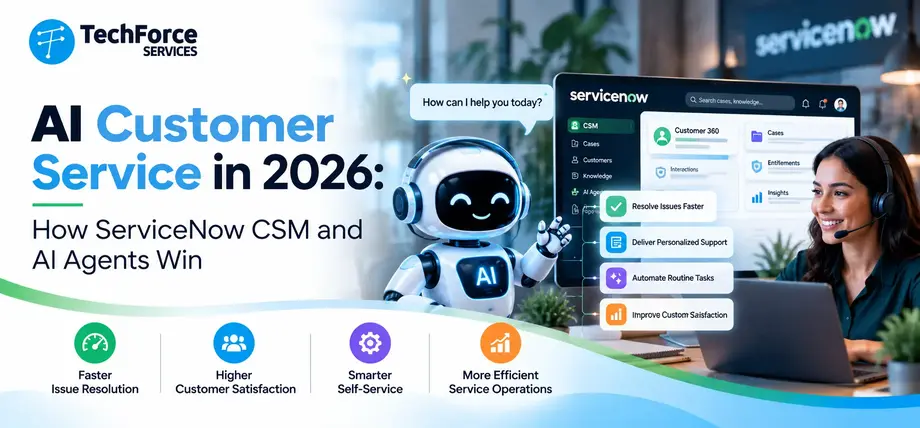
- ServiceNow CSM unites the front, middle, and back office on one intelligent platform.
- Generative AI agents complete tasks on their own and escalate with full context.
- Conversational self-service works across chat, portals and voice around the clock.
- A phased rollout with the right partner keeps risk low and value high.
Customers no longer compare your support with your competitors. They compare it with the best experience they have had anywhere. That is why AI customer service has moved from a side experiment to a core part of how modern service teams work. Instead of answering the same questions all day, teams now rely on intelligent systems that resolve routine requests, summarise conversations, and hand complex issues to people with full context. Here is how ServiceNow CSM brings these capabilities together, what AI agents do inside a service workflow, and how to roll them out without disrupting your teams.
What Is AI Customer Service and Why Does It Matter Now?
AI customer service uses generative AI, machine learning, and automation to handle support interactions that once needed a human. It covers conversational self-service, automatic case summaries, smart routing, suggested replies, and fully autonomous task completion.
The shift matters because customer expectations are rising faster than headcount. Gartner’s 2029 forecast predicts that agentic AI will autonomously resolve 80% of common customer service issues without human intervention, cutting operational costs by 30%. Teams that automate routine work free their people for conversations that need empathy and judgment. The real question is no longer whether to adopt AI customer service, but which platform gives you control, security, and a single view of the customer.
How ServiceNow CSM Powers Smarter Service Management
ServiceNow CSM goes beyond a traditional ticketing tool. It connects customer service with the teams behind the scenes, so an issue raised in chat can trigger work in billing, field operations, or engineering without anyone copying details between systems. This is service management built around outcomes not queues.
According to ServiceNow’s own CSM overview, the platform focuses on four goals: accelerating self-service, increasing agent productivity, speeding up resolution, and consolidating work on a single platform. In practice, that translates into:
- Case management: orchestrate complex issues across departments with a unified data model and automated workflows.
- Agent workspace: give agents one workspace with AI-generated case summaries, guided playbooks, and recommendations.
- Knowledge management: let AI agents draft and share relevant articles with customers and human agents.
- Predictive intelligence: anticipate customer needs and reduce case volume before tickets are even raised.
ServiceNow’s customer stories cite outcomes such as a 20% reduction in customer churn and 30% of key processes automated.
ServiceNow AI Agents: From Answering Questions to Taking Action
Earlier generations of automation answered questions. ServiceNow AI agents act. They are designed to work around the clock, gathering data, making decisions, and executing tasks toward predefined goals, from processing a return request to managing a product recall.
Inside CSM, prebuilt agents cover everyday scenarios such as triaging cases, pulling customer insight ,and taking case actions. Agents run under access controls, and user identities, so autonomy never comes at the expense of governance. You also switch on autonomous mode deliberately, workflow by workflow.
That is the practical meaning of AI agents for customer service: dependable digital teammates that take repetitive work off your people, not black boxes making unchecked decisions. Your human agents stay in charge of the complex, sensitive, and high-value cases.
Choosing AI Customer Service Software and Platforms
The market for AI customer service software is crowded, and feature lists look surprisingly similar. When you compare AI customer service platforms, look past the demo and evaluate what happens after the conversation starts:
- Unified data: can the AI see the full customer history across sales, service and field teams?
- Workflow depth: can it take action in other systems, or only suggest an answer?
- Governance: are permissions, audit trails and human approvals built in?
- Agent experience: does it make your people faster, or add another screen to manage?
- Time to value: are there pre-built workflows you can switch on quickly?
Bot, Chatbot or Agent: Know the Difference
An AI customer service bot usually follows defined flows to handle simple, repeatable requests such as order status or password resets. An AI customer service chatbot adds natural language understanding and generative responses, so conversations feel fluid and customers can phrase questions in their own words. An AI customer service agent goes further: it reasons through a goal, uses tools and completes work across systems.
Most organisations need all three. Start with a chatbot to deflect high-volume questions, then introduce agents for tasks such as case triage, refunds and follow-ups as confidence grows.
A Practical Roadmap to Roll Out AI Customer Service
Successful rollouts are rarely big-bang launches. A phased approach keeps risk low and builds trust with your teams:
- Audit contact reasons: Identify the top requests by volume and effort to find the best automation candidates.
- Fix your knowledge base: AI is only as good as the content and data behind it.
- Start with one workflow: Case triage and summaries are a safe, high-impact first step.
- Set guardrails: Define what agents may do alone, what needs approval and when to escalate.
- Measure and expand: Track resolution time, deflection and satisfaction, then scale what works.
Integration is where many projects stall, because customer data lives in several systems. Strong integration services connect ServiceNow with the CRM, billing and communication tools your teams already use, while ongoing managed services keep the solution tuned as volumes and products change.
Why Partner With TechForce Services
TechForce Services partners with ServiceNow to deploy AI agents, analytics and streamlined methods that improve customer experiences. By uniting the front, middle and back office on one intelligent platform, the aim is simple: increase revenue, boost productivity and build loyalty.
The value of TechForce Services’ ServiceNow partnership lies in pairing a powerful platform with specialist expertise, which means seamless deployment, rapid customisation and faster operational agility. With ISO 9001 and ISO/IEC 27001:2022 certifications and global delivery, our teams bring structure and security to every engagement. You can see how we deliver in our client case studies.

Final Thoughts
AI customer service is no longer a future trend. It is a competitive baseline, and ServiceNow CSM with AI agents gives teams a governed, scalable way to deliver it. Start small, measure honestly and expand where the results are clear. Book a free consultation with TechForce Services and map your first AI-powered workflow.
FAQ
Can AI agents replace human support teams?
No. AI agents handle routine, repeatable requests, while people keep complex and emotionally sensitive cases. Gartner expects agentic AI to resolve 80% of common issues by 2029, not all of them.
What can ServiceNow AI agents do in CSM?
Prebuilt agents triage cases, pull customer insights and take case actions around the clock. They run under access controls and user identities, with live-agent approvals where needed.
How do we start with AI customer service?
Begin with one high-volume workflow such as case triage, set clear guardrails, and measure resolution time and satisfaction before you expand.
What is the difference between an AI chatbot and an AI agent?
A chatbot answers questions in natural language, while an agent reasons through a goal, uses tools and completes work across systems, such as case triage or refunds.
Which AI models can ServiceNow AI agents use?
ServiceNow lets you choose the model provider, including its own Now LLM Service, Azure OpenAI, Google Gemini or Anthropic Claude on AWS.