Overview
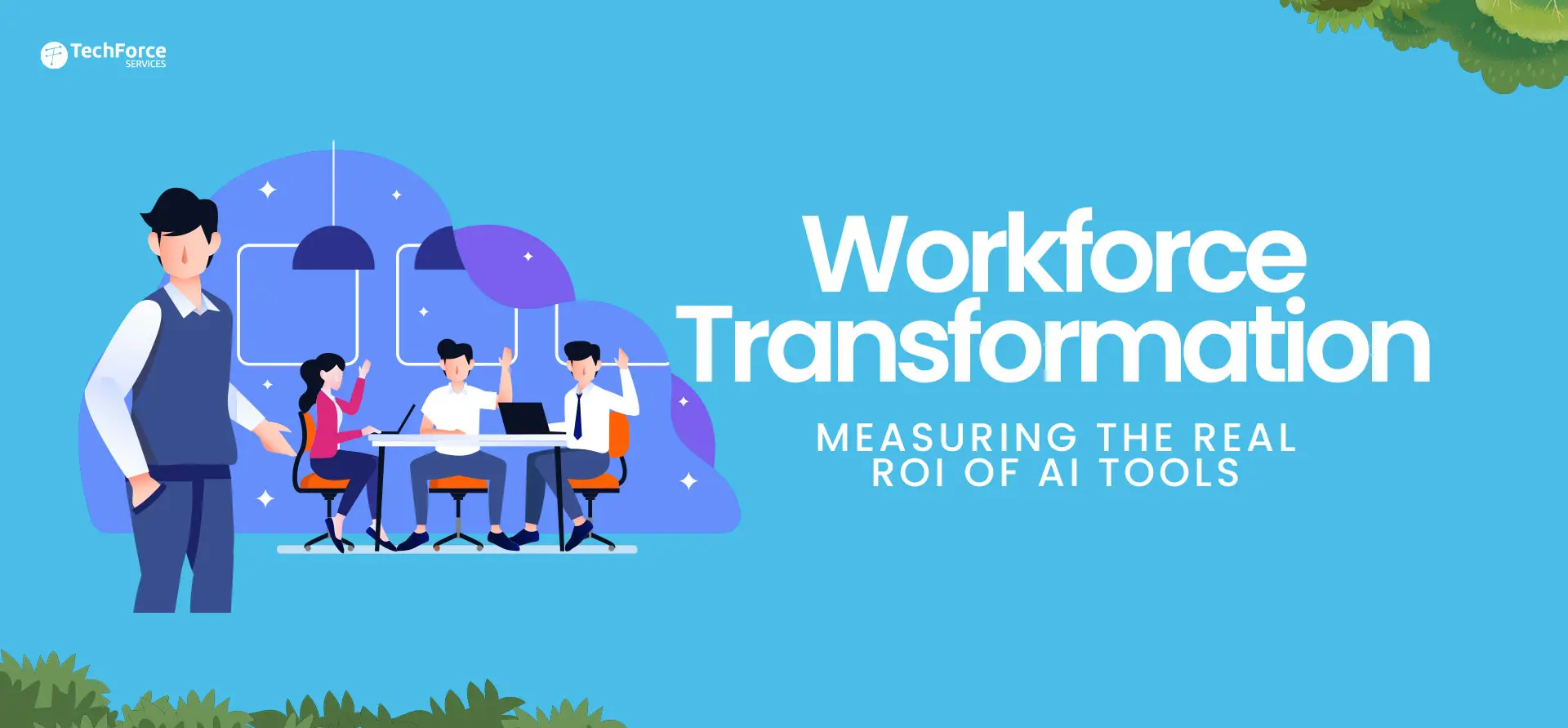
- Workforce Transformation: Shift focus from basic time-savings to driving true, long-term AI-driven business transformation.
- Agentic AI Adoption: Transition from simple copilots to deploying autonomous AI agents for business that handle complex workflows independently.
- Strategic Job Redesign: Build an enterprise AI strategy that actively moves employees from automating routine tasks to executing high value work.
- Measurable Business Value: Prove the real ROI of AI through reduced employee turnover and specialized vertical successes like AI in wealth management.
Most organisations measure AI success with a stopwatch — faster tasks, fewer steps, higher throughput. Efficiency matters, but if that is all you are tracking, you are missing the bigger picture of what AI-driven business transformation makes possible. Real workforce transformation is not just about automating routine tasks. It is about what happens after those tasks are cleared — whether your people are genuinely freed to do work that creates lasting impact.
Enterprises moving beyond early AI pilots are learning this quickly. The ROI of AI is not found in minutes saved — it is found in stronger client relationships, sharper clinical decisions, and lower attrition. Capturing that potential requires a deliberate enterprise AI strategy built around human outcomes, not operational speed.
Why Efficiency Is the Wrong Measure for Workforce Transformation
Efficiency is an incomplete goal. When AI helps employees move faster through low-cognitive work, there is a natural tendency to increase volume rather than redirect capacity toward high-value work.
Harvard Business Review research found that employees using AI tools often worked longer hours, took on more tasks, and experienced cognitive fatigue and burnout — the opposite of what workforce transformation should deliver. Automating routine tasks without redesigning how work flows does not create space; it creates pressure.
Ben Richards, Managing Director of Customer Growth and Transformation at Salesforce Canada, framed it directly: saving someone 10 to 15 minutes is only valuable if you know what they do with those minutes. The most meaningful ROI of AI comes when freed capacity flows into tangible, measurable outcomes.
That is where the benefits of Autonomous AI agents — and specifically agentic AI — become real. Agentic AI refers to systems that plan, execute, and adapt multi-step tasks autonomously, enabling AI agents for business to prepare briefings, triage requests, and surface insights without waiting to be asked.
High-Value Work in Action: Two Cases Worth Knowing
AI in Wealth Management: More Time for What Matters
RBC Wealth Management doubled its business between 2018 and 2025 and wanted to do it again in half the time — but its 2,200 advisors were already swamped with manual CRM updates, portfolio research, and meeting prep. Strategic client conversations were getting squeezed out.
The bank deployed AI agents for business through Salesforce Agentforce, building an agent that generates full meeting one-pagers in under a minute — a task that previously consumed an hour of manual prep. Advisors now enter conversations better prepared and have more time for the in-depth strategy discussions that drive growth. This is AI in wealth management done right: not replacing advisors, but amplifying what they can do.
Healthcare: When Automating Routine Tasks Improves Patient Outcomes
Sarah Duvall, a nurse practitioner at the University of Rochester Medicine with 25 years of experience, used AI to tackle high post-surgery readmission rates. Comparing readmission costs of over $3,000 per day against a prehabilitation programme at roughly $2,000 per patient, her AI-powered analysis revealed savings of $200,000 annually and over $900,000 across three years. She also used AI to craft a business proposal that leadership could act on — work she would not normally have had time to complete.
The prehabilitation pilot is now underway. Workforce transformation here meant a clinician using her expertise more fully: synthesising data, communicating with impact, and improving patient lives.
Enterprise AI Strategy Means Redesigning Work, Not Just Automating It
An enterprise AI strategy cannot bolt AI onto an existing org chart and expect workforce transformation to follow. The real benefits of AI agents only materialise when roles and workflows are redesigned around them. Richards describes what agentic AI makes structurally possible: frontline employees become managers of AI agents, directing autonomous systems instead of executing repetitive tasks. Managers lead both people and AI concurrently. Without this intentional redesign, freed-up time is absorbed into faster throughput rather than deeper work.
Organisations can protect high-value work by building deliberate pauses into workflows, batching non-urgent notifications, and creating space for strategic thinking and collaboration. Nikita Skylarov, co-founder of MokuHub, noted that the time AI freed at his company went to working together on harder problems, not working alone faster. That shift is what AI-driven business transformation looks like at the team level.
The Real ROI of AI: Retention, Engagement, and Human Potential
There is a direct line between workforce transformation and employee retention. When people apply their knowledge and judgment fully — rather than spending the day on manual, routine work — they experience a greater sense of purpose. That is one of the strongest predictors of staying in a role. Duvall put it simply: AI lets her do more of what brings joy to her work, spending time with patients and creating better outcomes. The ROI of AI at this level is human — and the business case for it, in reduced turnover and stronger relationships, is just as compelling as any efficiency metric.

The organisations winning with AI are not the ones moving fastest. They are the ones thinking most clearly about what they want their people doing once automating routine tasks clears the path. When agentic AI handles what machines do well, humans can focus on what only humans can do — judgment, creativity, empathy, and innovation. That is the true ROI of AI, and the only kind that compounds over time.