Key Takeaways
- Vulnerability management asks, “what is vulnerable?” while exposure management asks, “what actually puts your organization at risk?”
- CTEM is not a synonym for exposure management; exposure management is the broader goal; CTEM is specifically Gartner’s five-stage framework for achieving it continuously.
- CTEM vs traditional vulnerability management differs most on three points: scope (CVEs only vs. the full attack surface), prioritization (severity scores vs. business risk and exploitability), and validation (rarely tested vs. explicitly validated).
- Mature security programs don’t replace vulnerability management with CTEM; they keep vulnerability management as the operational process and add CTEM’s prioritization, validation, and mobilization on top.
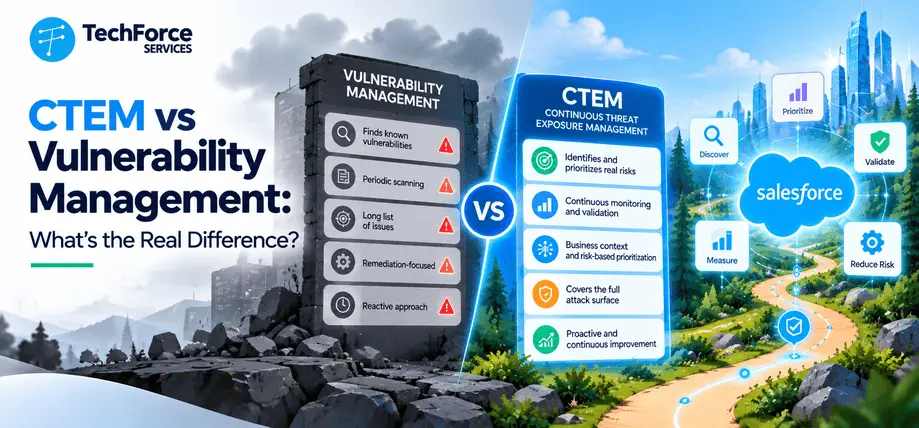
If you’ve seen “CTEM vs vulnerability management” content before, you’ve probably seen some version of a table claiming one approach is better than the other. And that’s the most common way organizations treat CTEM and vulnerability management, and it’s slightly misleading.
Vulnerability management vs. exposure management are not two different strategies competing with each other but are part of the same security process, just two different stages. Most of the guides explaining exposure management vs vulnerability management usually mention it as a comparison strategy.
In this article, we get specific about where vulnerability management and exposure management actually get different from each other; we clarify the difference between exposure management and CTEM specifically and explain practical ways for security teams to move from a vulnerability management program to a CTEM-driven exposure management approach. We have also mentioned some points where organizations mostly make mistakes while moving from traditional vulnerability management to a CTEM approach.
What Is Vulnerability Management?
Vulnerability management is the strategy to identify, classify, and remediate known security weaknesses in software and systems in any organization. Most commonly, Common Vulnerabilities and Exposures (CVEs) are tracked against a standardized severity score (CVSS).
In a practical way, vulnerability management is a recurring process that scans systems and applications on a scheduled basis for vulnerabilities, often weekly, monthly, or quarterly; ranks the results based on severity score; and assigns them to relevant teams for fixing them.
Vulnerability management is necessary work, as any type of vulnerability is a common way attackers get into the system. CTEM, or exposure management, is the top layer to manage any kind of security exposure that vulnerability management provides.
Vulnerability management has its own limitations. It rarely validates whether a given vulnerability is actually exploitable in your specific system environment. It’s just a scanner report that tells you about CVE existence. It does not validate whether your particular segmentation or configuration would actually allow an attacker to use it. The organization gets less insight into misconfigurations, excessive permissions, or exposed credentials, which are how real breaches happen.
What Is Exposure Management (and How Does CTEM Fit In)?
Exposure management is the broader cybersecurity discipline focused on identifying, assessing, and reducing the exposures that create real, exploitable risk to an organization. It helps organizations look at security the way any attacker would. So rather than simply ranking every weakness, it helps solve the actual questions about what actually puts your organization at risk.
CTEM (Continuous Threat Exposure Management) is not another name for exposure management; it’s Gartner’s specific framework for operationalizing exposure management as a continuous, repeatable process.
Exposure management’s goal is achieved through CTEM’s five-stage cycle (scoping, discovery, prioritization, validation, and mobilization) that Gartner designed for a continuous process. CTEM is a part of the exposure management process, a framework that helps an organization be safe from security threats.
An organization can genuinely practice exposure management principles without formally adopting every stage of CTEM. We have explained CTEM in detail for organizations that are looking to adopt the CTEM framework for exposure management: What Is CTEM? Continuous Threat Exposure Management Explained
Vulnerability Management vs Exposure Management: The Core Differences
Vulnerability Management | Exposure Management (via CTEM) | |
Core question | “What is vulnerable?” | “What actually puts the organization at risk?” |
Perspective | Asset-centric: Focus on what weaknesses/threats the organization has and whether they are patched. | Attacker-centric: Focused on how any threat would actually be exploited. |
Scope | Known CVEs on servers, endpoints, and applications. | CVEs plus misconfigurations, identity risk, excessive permissions, credential exposure, attack paths, and third-party/SaaS exposure. |
Prioritization | Generic severity score (CVSS) | Real-world exploitability, asset criticality, attack path, active threat intelligence, and business impact. |
Cadence | Periodic, scheduled scans, often quarterly; annual penetration tests | Continuous, ongoing cycle |
Validation | Rarely tested against actual exploitability | Explicit validation stage, often via breach and attack simulation |
Typical tools | Vulnerability scanners, patch management systems. | Attack surface management platforms, Adversarial Exposure Validation (AEV) tools, and threat intelligence feeds. |
Output | Lists of findings ranked by severity | A prioritized, validated remediation plan tied to business risk |
Vulnerability management’s job (finding and tracking known CVEs) still needs doing, and exposure management depends on that data as one of its core inputs.
CTEM vs Traditional Vulnerability Management, Stage by Stage
Let’s see the difference between CTEM and traditional vulnerability management through CTEM’s own five stages to find out the gap between the two.
- Scoping: Traditional vulnerability management programs rarely include a separate scoping phase; instead, they choose to scan whatever happens to be on their existing asset list. CTEM treats scoping as a business decision; this stage is focused on the systems that matter most to the company’s operations.
- Discovery: While traditional vulnerability scanning only looks for software bugs on known devices, CTEM’s discovery phase covers much more, including misconfigurations, identity risk, and discovering hidden assets across the entire environment.
- Prioritization: Traditional vulnerability programs rank risks using generic technical scores (CVSS severity) alone, which is where the two models differ most. CTEM’s prioritization stage prioritizes real-world exploitability and business context to show how a flaw actually impacts the company.
- Validation: Traditional vulnerability programs usually skip this step or have no equivalent stage at all; they send every discovered flaw straight to the IT department’s to-do list. CTEM introduces a validation step to test and prove whether a vulnerability can actually be breached before asking teams to fix it.
- Mobilization: Traditional vulnerability management simply routes tickets to IT teams for patching without broader coordination, while CTEM’s mobilization phase builds a cross-functional ownership structure to ensure security and IT teams collaborate to lower actual risk.
Do You Need to Choose Between CTEM vs Vulnerability Management?
Organizations that try to replace vulnerability management with a CTEM program usually face problems quickly. It happens because they lose the baseline that catches the large volume of routine, genuinely urgent CVEs.
Organizations don’t have to choose between these two but need to run vulnerability management as a continuously feeding input for a broader exposure management process. For organizations, it means your current security scanners stay active and run exactly as they do now.
By using CTEM, instead of giving a list of technical scores straight to IT, these flaws are tested and verified first, ensuring your team does not waste time on minor issues while leaving hidden, highly dangerous threats open.
How to Transition from Vulnerability Management to CTEM
Moving from a basic vulnerability program to a CTEM strategy does not mean replacing your current security tools. Here is a process that you can follow for a smooth transition between the two; follow the steps given below:
- Keep your vulnerability scanning running: Keep your existing vulnerability tools active; they can now serve as data feeds rather than the entire program. Do not replace them, but just change how you use their reports.
- Prioritize using business context first: The quickest, most cost-effective upgrade is layering business importance and potential attack paths over technical scores. It means prioritizing what’s important for business rather than sorting risks by generic severity (CVSS) alone.
- Verify threats before fixing them: Before spending time and resources to fix anything ranked by the vulnerability management process, confirm if the flaw it flagged is actually dangerous in your specific network by using breach simulation tools or pentesting.
- Broaden your view gradually: Add misconfigurations, identity and access risk, and SaaS/third-party exposure to what you’re assessing. But add everything gradually instead of attempting to cover the entire attack surface on day one.
- Assign clear owners to execute fixes: Decide who outside the security team, whether it’s the IT manager, application owners, or business leaders, is responsible for fixing verified risks. Poor cross-team coordination is where most programs fail; your organization needs to fix it ASAP.
- Move from a periodic to a continuous cycle: Once the steps we listed work smoothly on a small scale in the transition phase from the traditional vulnerability management process to CTEM. Make sure the process runs continuously rather than as a one-time project. And only add new systems to the scope after your current cycle runs automatically.
Transitioning from the old process to the new continuous process is a task that takes many steps that your security team needs to take care of. That’s why an experienced CTEM service partner is recommended to make the transition smooth without you worrying about missing any step.
Common Mistakes When Making the Shift
Here are some common mistakes organizations make when they move from a traditional vulnerability management process to the continuous threat management process; avoid these mistakes for a smooth transition:
- Treating the transition as a tooling purchase instead of an operational change: Buying an attack surface management tool or a testing platform will not magically improve your security if you do not change how your teams actually prioritize and fix the data. So, fix your operational process first, as we mentioned above, step by step.
- Dropping vulnerability management completely: Some businesses mistakenly think upgrading to CTEM means stopping their older scanning programs. It actually causes them to lose the basic patching habits that are needed to catch everyday software bugs.
- Testing every single flaw instead of focusing only on top priorities: Simulating attacks to verify risks takes a lot of time and effort, and doing this blindly for every alert completely defeats the purpose of ranking your risks in the first place.
- Expanding scope faster than the team can operationally handle: Don’t add misconfiguration, identity, and third-party exposure all at once before your basic workflow is stable. It will help your teams with a smooth transition from the traditional vulnerability management process to the continuous threat management process.

Conclusion
Comparing vulnerability management to exposure management is not what organizations think. CTEM is not a replacement for vulnerability management because they serve completely different purposes. Vulnerability management serves as your basic maintenance layer; it is used to ensure everyday software flaws are tracked and patched.
Exposure management, built on Gartner’s CTEM model, acts as your strategic framework. It helps organizations look beyond software bugs via a 5-stage process to determine exactly where your team should focus or which risks to prioritize first and ensure those fixes actually happen.
The real difference between vulnerability management and exposure management isn’t which one is better; it’s that one feeds the other, and established security programs run both together rather than picking one.
Most companies maintain solid traditional vulnerability habits but lack mature exposure management practices or, on rare occasions, experience the opposite problem. A brief, strategic discussion with a CTEM service partner can help pinpoint exactly where your current operations fall and identify your highest-value next step.
Frequently Asked Questions
What is the difference between vulnerability management and exposure management?
Vulnerability management helps in identifying and patching known software flaws (CVEs), prioritized by generic severity scores. While exposure management adopts an attacker’s perspective of your entire environment that includes catching cloud mistakes, misconfigurations, and identity risks and prioritizes based on real business impact rather than prioritizing based on severity alone.
What is CTEM, and how does it relate to exposure management?
CTEM (Continuous Threat Exposure Management) is Gartner’s specific five-stage framework for achieving exposure management on an ongoing, continuous basis. Exposure management is the broader goal; CTEM is the repeatable process Gartner designed to achieve it.
Does CTEM replace vulnerability management?
No. CTEM is built on vulnerability management rather than replacing it; vulnerability scanning and patching remain the operational foundation, while CTEM adds prioritization, validation, and cross-team mobilization for better coordination of vulnerability management.
What tools are used for exposure management versus vulnerability management?
Vulnerability management relies on vulnerability scanners and patch management systems. On the other hand, exposure management, delivered through CTEM, typically keeps those tools and adds attack surface management platforms, Adversarial Exposure Validation (AEV), or breach-and-attack-simulation tools, and threat intelligence feeds to the existing system.
What's the biggest mistake organizations make when comparing CTEM vs vulnerability management?
Most organizations treat it as an either/or decision while comparing. The comparison is useful for understanding what each approach actually does, but the organizations that benefit most are the ones that use the comparison to identify gaps in their current vulnerability management program. We suggest not using the comparison to justify discarding vulnerability management altogether.