
Introduction
What is the single most important step to successfully implementing AI agents? Consider these examples of AI systems gone awry: an airline forced to reimburse a traveler after an AI bot provided incorrect information about its bereavement policy, a bot advising New York entrepreneurs it was okay to break certain laws, or an AI system mistakenly accusing an NBA star of vandalism.
What caused these failures? While oversight and guardrails are crucial, the root problem often lies in the data. Issues like bad or mislabeled data, unknown sources, or fragmented customer data can derail even the most advanced AI agent tools.
The research underscores this challenge: nearly 60% of AI users report difficulty achieving desired outcomes, with over half admitting distrust in the data used to train AI models. This lack of trust is a significant barrier to AI adoption and competitiveness.
AI agents, like Salesforce’s Agentforce, have the potential to revolutionize customer interactions and workflows. But this hinges on clean, accurate, and accessible data—what is known as data-centric AI. This approach emphasizes building AI systems on high-quality data, ensuring reliable outputs and better customer experiences.
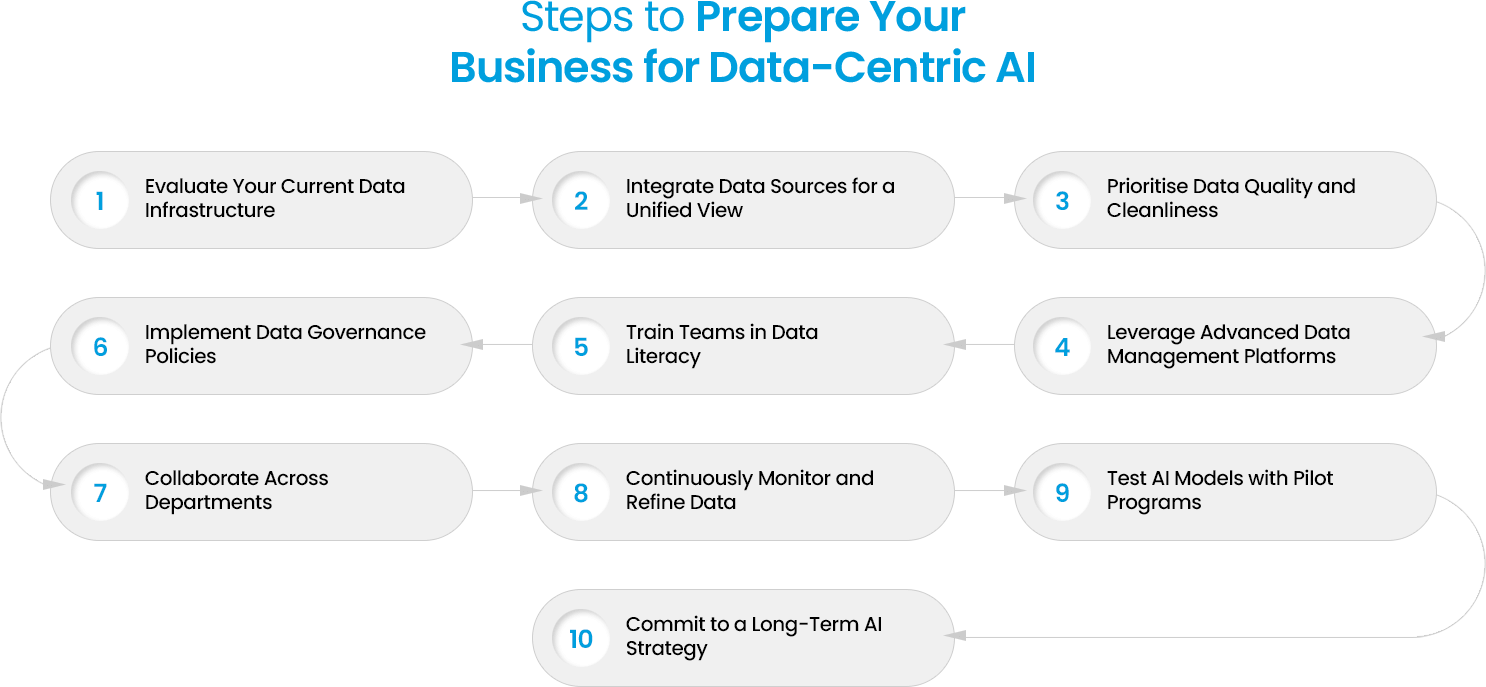
Steps to Prepare Your Business for Data-Centric AI
Implementing data-centric AI is a transformative journey that requires careful preparation and execution. Here are the essential steps businesses can take to lay the groundwork for success with data-centric AI and harness its potential to revolutionize operations, improve customer interactions, and enhance decision-making.
1. Evaluate Your Current Data Infrastructure
Start by assessing your existing data infrastructure. Identify where your customer data is stored, whether structured or unstructured and the systems that manage it. Determine if your data is centralized or scattered across silos. This evaluation will give you a clear picture of the gaps that need to be addressed before introducing AI models.
2. Integrate Data Sources for a Unified View
Data-centric AI thrives on unified and comprehensive datasets. Integrate data from multiple sources, such as marketing, sales, service, and commerce, into a centralized system like Salesforce Data Cloud. This integration ensures that your AI agent tools have access to real-time, harmonized data that drives accurate and effective outcomes.
3. Prioritize Data Quality and Cleanliness
Dedicate time and resources to improving data quality by eliminating duplicates, correcting errors, and addressing missing or incomplete data. A clean and reliable dataset enhances the performance and reliability of AI models, reducing the risk of errors and biases.
4. Leverage Advanced Data Management Platforms
Adopt advanced platforms like Agentforce Salesforce that support data unification, cleaning, and analysis. Tools like these streamline the preparation of high-quality datasets and provide AI agents with the context needed to improve customer interactions and decision-making processes.
5. Train Teams in Data Literacy
For data-centric AI to succeed, your teams must understand the importance of data and how it fuels AI agent tools. Invest in training programs that enhance data literacy, enabling employees to effectively manage and utilize customer data while aligning with AI-driven objectives.
6. Implement Data Governance Policies
Establish robust data governance policies to ensure data integrity, security, and compliance. Assign roles and responsibilities for data management, and create protocols for accessing, updating, and sharing data across the organization. This minimizes the risk of data misuse and ensures accountability.
7. Collaborate Across Departments
Data preparation for AI is not limited to the IT department. Involve stakeholders from marketing, sales, customer service, and other departments to identify valuable data points and align on shared objectives. Cross-departmental collaboration ensures that the AI system supports the needs of the entire organization.
8. Continuously Monitor and Refine Data
Data is dynamic, and its performance can change over time. Establish mechanisms to continuously monitor and refine your datasets to remain accurate and up-to-date. Regular audits and updates will help your AI models deliver consistent, high-quality results.
9. Test AI Models with Pilot Programs
Before deploying AI systems at scale, run pilot programs to test the effectiveness of your data-centric AI solutions. Analyze the outcomes, gather feedback, and make necessary adjustments to the data and AI models. Pilot testing minimizes risks and builds confidence in the AI system.
10. Commit to a Long-Term AI Strategy
Adopting data-centric AI is not a one-time project but an ongoing journey. Develop a long-term strategy that outlines your goals for AI implementation, continuous data improvement, and technological advancements. This ensures your business remains competitive and capable of adapting to future innovations.
Connecting Enterprise Data for AI Systems
Real-time access to harmonized data is the foundation of successful AI agent tools. Yet, many organizations face challenges due to siloed and unstructured data. This fragmentation limits the value derived from AI systems.
Platforms like Salesforce Data Cloud offer a solution by integrating all structured and unstructured data into a unified system. Recent updates enable the processing of audio and video, along with a semantic data model that enhances contextual understanding for AI agents.
This integrated data powers tools like Agentforce Salesforce, making AI agents contextually aware. For instance, an Agentforce Service Agent can access customer data from emails, support tickets, voicemails, and other sources to deliver personalized customer interactions. This enables the next-best actions, such as automating follow-ups or generating detailed chat summaries for human representatives.
Laying the Groundwork for Clean Customer Data
Clean data is essential for building reliable AI agent systems, such as those powered by Agentforce. The following steps can help:
- Remove duplicates and irrelevant data — Duplication often occurs when combining datasets from multiple sources, while irrelevant data may not align with the specific problem being analyzed.
- Correct structural errors — Typos, inconsistent capitalization, or mismatched formats (e.g., “N/A” vs. “not applicable”) can hinder accurate analysis by AI models.
- Filter outliers — Identify and remove one-off observations caused by data entry errors unless they provide valuable insights.
- Address missing data — Missing data can be resolved by eliminating incomplete observations, imputing missing values, or adapting the analysis to account for gaps.
- Validate the data — After cleaning, ensure the data aligns with logical rules, supports your analysis, and surfaces actionable insights.
Data-Centric AI: The Backbone of the Future
Data is no longer just a support function—it is becoming the backbone of AI systems, workflows, and customer interactions. Integrated, high-quality data will enable businesses to make informed decisions, power real-time actions, and seize new opportunities. AI agent tools, like those in Agentforce Salesforce, depend on this foundation for success.
By leveraging platforms like Salesforce Data Cloud and focusing on data-centric AI principles, organizations can differentiate themselves on a massive scale.
Conclusion
The rise of data-centric AI has underscored the importance of clean, unified, and trustworthy customer data. Tools like Agentforce and Salesforce Data Cloud exemplify how businesses can use robust AI systems to enhance customer interactions and streamline operations.
To achieve success, businesses must prioritize data quality and connectivity, enabling AI agents to operate with accuracy and efficiency. By embracing these principles, organizations can unlock the full potential of AI agent tools, leveraging insights and automation to deliver exceptional experiences. With the right approach, AI models and systems powered by data-centric AI will transform the way companies operate and engage with their customers.