
In today’s fast-evolving digital environment, organizations depend heavily on Salesforce to streamline operations, drive customer engagement, and ensure long-term scalability. But leveraging Salesforce to its fullest capability goes beyond just having a working system—it requires continuous refinement and technical precision.
Salesforce deployments need to be managed and optimized effectively, and that’s where working with a skilled and trusted partners makes all the difference. By adopting professional-managed services and deployment best practices, businesses can significantly reduce risks, reduce downtime, and enhance overall CRM performance.
The Role of Expert Partners in Salesforce Deployments
Deploying Salesforce is not just about initial configuration. It involves a strategic combination of release management, testing automation, sandbox usage, and deployment tools that ensure seamless transitions between environments. A reliable Salesforce managed services partner brings deep domain knowledge and hands-on technical expertise to build a robust deployment pipeline.
Experienced Salesforce consultants understand the intricacies of metadata handling, deployment sequencing, version control, and rollback strategies. They bring best-in-class tools and automated workflows that enhance deployment accuracy and efficiency.
Working with a Salesforce team allows your team to learn and implement proven methods, ensuring that Salesforce deployments are both technically sound and aligned with your business roadmap.
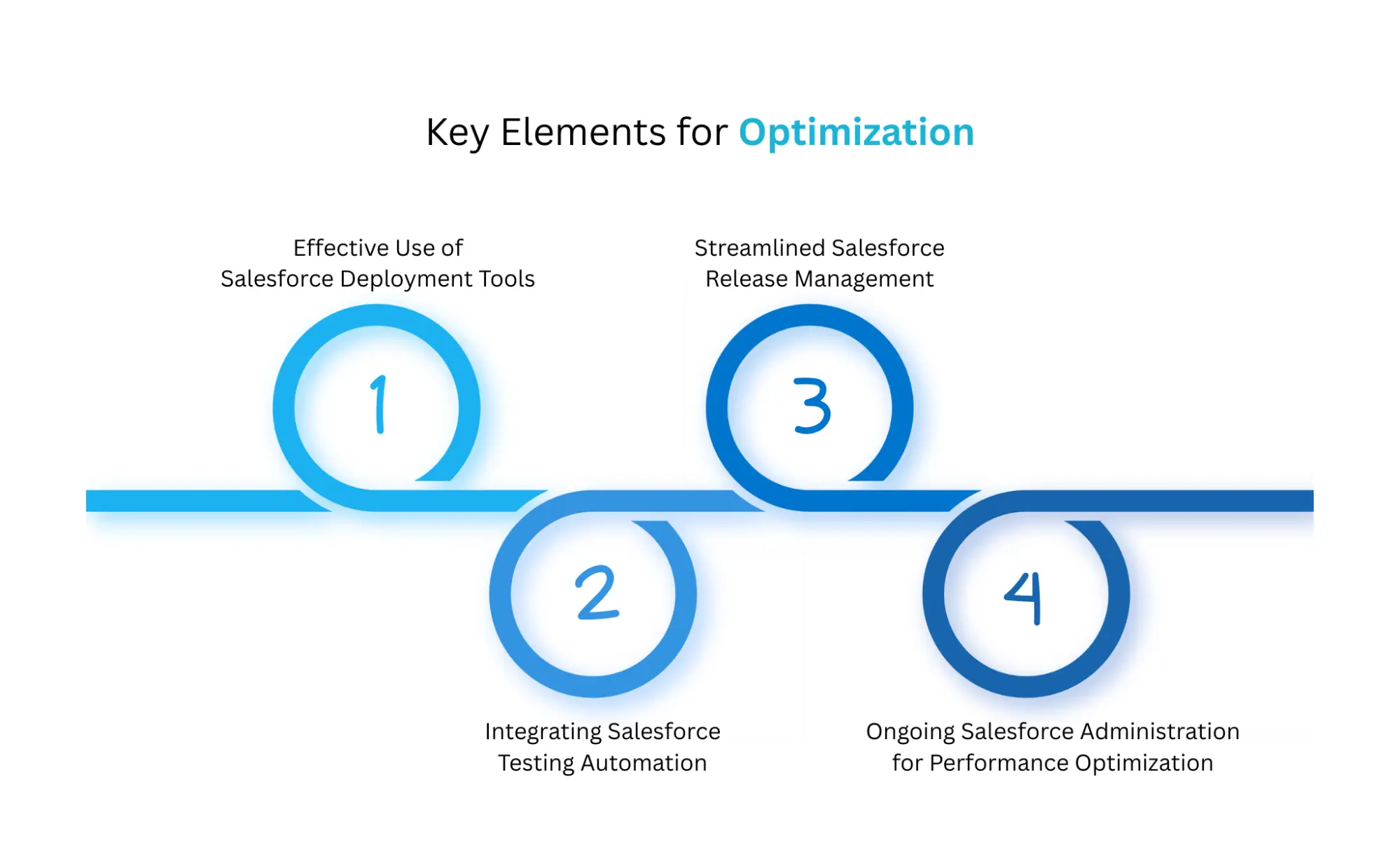
Key Elements for Optimization
1. Effective Use of Salesforce Deployment Tools
Salesforce deployment tools like Salesforce CLI, Change Sets, and third-party CI/CD platforms play a critical role in simplifying and scaling deployment processes. With proper configuration and usage, these tools automate metadata migration, validate deployments in advance, and reduce the chances of human error. This also ensures traceability and governance over every code and configuration change.
When guided by an expert partner, these Deployment tools become powerful assets in ensuring business continuity and rapid release cycles. A managed services provider can help customize these tools to match the unique needs of your Salesforce environment, enabling smooth operations and proactive issue resolution.
2. Integrating Salesforce Testing Automation
To ensure deployment success, Salesforce testing automation must be embedded throughout the development lifecycle. By leveraging test automation, businesses can validate features, identify integration conflicts, and ensure that every release maintains platform integrity. Automated testing reduces manual errors, saves time, and strengthens confidence in production readiness.
Salesforce testing automation includes unit tests, functional testing, and regression testing—key practices recommended by every trusted consultant. By incorporating tools like Selenium, Provar, or native Salesforce DX testing frameworks, companies can maintain continuous quality assurance within their Salesforce deployment pipeline.
3. Streamlined Salesforce Release Management
Structured release management is essential for deploying new features without disruption. This process includes versioning, change tracking, and controlled rollouts. By involving a Salesforce MSP, organizations benefit from an outside-in view on managing complex release schedules and ensuring that critical business processes remain uninterrupted.
Effective Salesforce release management ensures that stakeholders are aligned, rollback plans are in place, and each release is thoroughly validated before hitting production. It also supports compliance and audit requirements for organizations in regulated industries.
4. Ongoing Salesforce Administration for Performance Optimization
Salesforce administration is not a one-time task. It requires continuous monitoring, data hygiene checks, security reviews, and performance tuning. Businesses often rely on Salesforce managed services to align administrative tasks with evolving business strategies.
Proper data modeling, regular cleanup of unused fields and automation, and role-based access control reviews are just a few ways administrators can support optimized Salesforce deployments. Leveraging experienced Salesforce consultants ensures these tasks are performed systematically.
Ready to optimize your Salesforce deployments with expert guidance?
Best Practices for Deployment Optimization
- Adopt a version-controlled deployment approach using Salesforce deployment tools
- Integrate automated testing across development and staging environments
- Maintain an organized sandbox strategy with environment-specific workflows
- Collaborate with a Salesforce partner for governance and technical audits
- Plan release cycles with rollback procedures and documentation
- Use data migration best practices to prevent integrity issues during deployments
- Train internal teams for self-sufficiency
- Monitor system performance continuously and benchmark improvements post-deployment
These practices not only reduce deployment errors but also promote faster innovation, enhanced collaboration, and long-term system resilience.
Why Partner with Salesforce Managed Services to Optimize Deployments?
Whether you’re scaling existing deployments or launching new Salesforce solutions, the value of having expert guidance cannot be overstated. Their technical expertise helps:
- Customize deployment pipelines with the right tools
- Implement Salesforce testing automation to boost quality assurance
- Govern release cycles with end-to-end Salesforce release management
- Offer strategic administration support for scalability
- Support sandbox management and data masking for secure development environments
- Identify optimization opportunities in user adoption, page load speed, and configuration
Partnering with a right team ensures a holistic approach to CRM deployment. Beyond just technical knowledge, these partners bring strategic insight that can help you forecast demand, scale functionality, and enable better ROI.
Conclusion
Optimizing Salesforce deployments is an ongoing journey that requires expert oversight, intelligent tooling, and a best-practice mindset. Partnering with a seasoned MSP enables businesses to navigate technical complexity with confidence.
With the right combination of Salesforce deployment tools, testing automation, release management, and expert Salesforce consultants, organizations can ensure high-performing, reliable, and scalable Salesforce environments.
Whether you’re an enterprise or an SMB, engaging with the experienced partner will elevate your deployment success and future-proof your CRM investment. Investing in strong administration and aligning with experienced Salesforce implementation consultants is a proactive step toward maintaining a robust Salesforce platform that evolves with your business.