Key Takeaways
- Continuous threat exposure management (CTEM) is a five-stage cybersecurity framework created by Gartner in 2022; it’s a structured, repeating process for reducing an organization’s security exposure. CTEM is not a tool or product; it’s a framework/process to reduce security risks.
- CTEM is a five-stage framework introduced by Gartner; these five stages are Scoping, Discovery, Prioritisation, Validation, and Mobilization. These stages run as an ongoing cycle rather than a one-time project.
- Gartner predicted that organizations prioritising security investment through a CTEM program would be 3x less likely to suffer a breach.
- CTEM, compared to traditional vulnerability scanning, expands its scope to misconfigurations, identity risk, excessive permissions, and credential exposure, not just known CVEs (Common Vulnerabilities and Exposures).
- “CTEM” is not a single product; instead, organizations combine tools across categories like Exposure Assessment Platforms (EAP) and Adversarial Exposure Validation (AEV) to support a CTEM program.
If your security team already knows it has more vulnerabilities than it can possibly fix. Then the problem is that your organization does not just have the scanning capabilities but also lacks a structured way to decide which vulnerabilities & exposures actually matter. A continuous process that can protect and prove that your organization is actually getting safer over time is needed. That’s what continuous threat exposure management does: it solves this exact problem as a continuous process.
This guide explains what CTEM (continuous threat exposure management) is in simple terms and walks through all five stages of the CTEM framework, covering where it came from and why CTEM cybersecurity programmes are gaining traction so quickly.
We also cover the benefits of CTEM for organizations and where organizations commonly stall in CTEM implementation, whether you’re building a program from scratch or trying to understand why your security leadership keeps bringing it up to the highlight.
What Is Continuous Threat Exposure Management (CTEM)?
Continuous threat exposure management, or CTEM, is a five-stage framework created by Gartner in 2022. CTEM is designed to help businesses continuously scope, discover, prioritize, validate and mobilize (fix) security exposures across their entire digital footprint. Basically, it helps organizations move away from reactive, once-a-year security checks into a continuous loop of risk management.
Gartner’s own definition of CTEM is an ongoing business process that helps organizations continuously assess how easily their physical and digital assets can be targeted and broken into. It is used to evaluate accessibility, exposure, and exploitability of their digital and physical assets.
The single most important thing to understand about the meaning of CTEM, and the point where a lot of confusion comes from is that it is not a technology, a platform, or something you can buy from a single vendor. No security vendor sells “CTEM” as a product; in the same way, no vendor sells “compliance” as a product.
Instead, CTEM is an operating model/framework: a repeatable cycle of activities that organizations run continuously, typically supported by a combination of tools across several different technology categories.
What is continuous threat exposure management trying to solve for businesses, specifically? While traditional vulnerability management generates thousands of CVEs, misconfigurations, and alerts, it provides very little built-in guidance on which ones actually pose a realistic threat to the business. This leaves security teams either overwhelmed and paralysed by too many alerts or forced to prioritize based on generic severity scores (like CVSS ratings) that don’t give full visibility of whether the security risk impacts a critical business asset or not.
CTEM solves this by pairing continuous scanning with your specific business context, so the question shifts from “How many vulnerabilities do we have?” to “What should we fix first, and why?”
Where Did CTEM Come From? Gartner's Framework Explained
Let’s start by understanding why Gartner created CTEM, which explains exactly why the framework is designed this way. Gartner launched CTEM in 2022 because executives felt highly unprepared for major security threats, even though their teams were producing more risk data than ever. Traditional vulnerability management methods focused only on scanning for known CVEs (common vulnerabilities and exposures) on a periodic/quarterly basis. This failed to give leaders the clear, business-focused direction they needed to make decisions.
By 2023, Gartner named CTEM one of its top cybersecurity trends for the year, and its adoption took off from there by other organisations. In 2024, Gartner introduced two supporting categories to support its strategy: one was Exposure Assessment Platforms (EAP), which help organizations continuously discover and assess their attack surface, and the other was Adversarial Exposure Validation (AEV), which simulates real attacks and proves which risks are actually dangerous. These two tool categories exist simply to help run the CTEM programme to support organizations.
Gartner’s 2025 Magic Quadrant for Exposure Assessment Platforms named Tenable, Rapid7, and Qualys as leaders in that specific category, which gives some sense of where the more mature commercial tooling around CTEM currently sits.
Gartner’s main goal for CTEM is to create a clear security improvement plan that executives can easily understand, and technical teams can immediately execute. Connecting technical security flaws to high-level business decisions is the main goal across all five steps of the program for security improvement.
The 5 Stages of CTEM (Quick Overview)
Traditional security projects operate on a linear timeline: you scan, you get a report, you patch the flaws, and the project is considered complete until the next scheduled assessment. CTEM rejects this linear approach because corporate attack surfaces change constantly. CTEM replaces this with an ongoing, closed-loop operating model that never stops running.
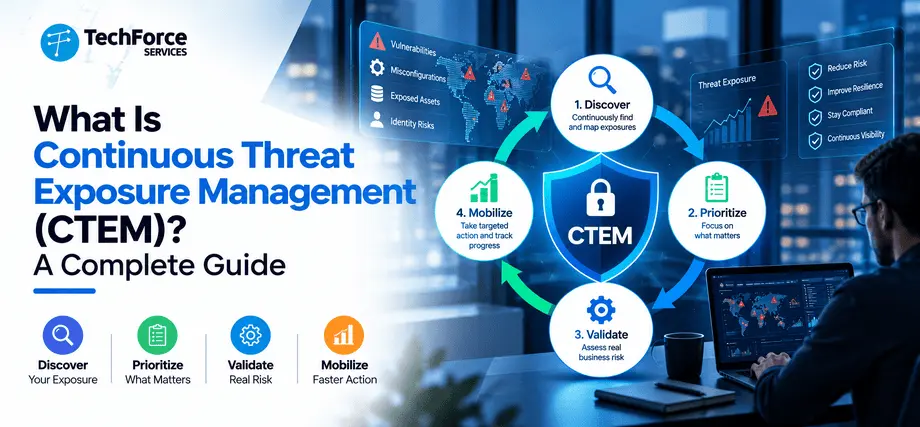
CTEM runs as a continuous, repeating cycle that has 5 stages: Scoping, Discovery, Prioritization, Validation, and Mobilization. That means as soon as one risk is fixed in the Mobilization phase, the environment changes, immediately triggering the next round of scoping and discovery.
Here are the 5 stages of the CTEM framework that work in a continuous loop:
- Scoping: It defines which assets, systems, and attack surfaces are actually in scope, according to the business priorities rather than a purely technical inventory. This means scoping is used to define exactly which systems and data need protection based on business priorities.
- Discovery: Discovery is used to actively hunt for assets, vulnerabilities, and misconfigurations within that scope on a continuous basis rather than a periodic scan cycle. The business-priority scope is discovered here.
- Prioritisation: During prioritisation, the risks are ranked based on actual business impact, current security controls, and real-world danger rather than generic technical errors.
- Validation: Validation uses simulated attack techniques to test whether hackers can actually exploit these prioritised risks in your organisation’s specific environment.
- Mobilization: Mobilization is used to make sure teams actually fix the tracked issues. It is the stage that actually determines whether the CTEM programme actually reduces risks or just creates reports. That was the whole purpose of the CTEM framework: to reduce risk, not just create a report about it.
After mobilization, once these fixes are deployed, the cycle immediately resets rather than ending like a traditional project, which serves the purpose of a continuous threat exposure management framework.
CTEM vs. Traditional Vulnerability Management (Quick Comparison)
So the main concern of organizations is whether traditional vulnerability management is being replaced, but it’s actually being upgraded. While traditional programmes stop after finding and patching software bugs (CVEs), threat exposure management expands the view to include misconfigurations, identity risks, and human errors.
This is an upgrade from using traditional scanning tools to a broader threat management framework that adds business context and active attack simulations. Overall, this moves your security team from simply counting vulnerabilities to continuously validating and neutralising risks.
Here are the major differences between CTEM and traditional vulnerability management:
Traditional Vulnerability Management | CTEM | |
Frequency | Periodic (often quarterly) scans | Continuous, ongoing cycle |
Scope | Primarily known CVEs on servers and endpoints. | CVEs, misconfigurations, identity risk, excessive permissions, credential leaks, SaaS and third-party exposure. |
Prioritisation | Generic severity scores (e.g., CVSS). | Real-world exploitability, business context, and threat intelligence combined. |
Validation | Rarely tested against actual exploitability. | Explicit validation stage, often using simulated attack techniques. |
Output | Lists of findings. | An actionable remediation plan tied to business priorities. |
Why CTEM Cybersecurity Programs Matter Right Now
Several market points explain why CTEM quickly evolved in such a short time and moved from a technical concept to a top business priority. A Gartner survey found that 71% of organizations believed they could benefit from CTEM as they see a clear scope of it, and 60% are already planning for it. This proves that enterprises are recognizing and adapting it.
In recent years, IBM’s Cost of a Data Breach Research shows the average cost of data breaches has continued to rise to millions of dollars globally, which is why CTEM is the perfect framework to secure organizations from such breaches and help them save millions.
Gartner also provided a clear, measurable metric for the success of CTEM by 2026, predicting that businesses using a CTEM programme would be three times less likely to suffer a breach by 2026. And in 2026, we are now evaluating results to see how this adapting framework has worked for organizations in real-time scenarios.
Benefits of a CTEM Program
Organizations that implement CTEM well see its benefits in several ways, and it’s better than finding just software bugs.
We list out a few benefits of the CTEM framework below:
- Smarter prioritisation: Security teams can stop treating every security/bug alert as a crisis, allowing them to focus their limited time and resources strictly on dangerous, high-impact risks for the organization.
- Less alert fatigue: CTEM helps organizations by filtering out low-risk alerts based on real business context. It saves teams from wasting valuable time on minor issues that do not threaten the company.
- Clear executive reporting: Because CTEM connects technical risks directly to business outcomes, the security team can now explain threats and justify budgets using business terms that executives actually care about.
- Broader security coverage: CTEM helps organizations cover security gaps beyond CVEs that include misconfigurations, identity risk, and third-party app risks. Traditional vulnerability management programmes often miss these due to their limited scope and periodic checks.
- Continuous, measurable process: Instead of providing one-off snapshots like the traditional CVE programme, CTEM provides an ongoing way to monitor and prove security is improving over time. It directly solves the goal of an organization and gives technical teams or executives a clear plan to act on.
How to Get Started with CTEM, Guided by TechForce
While building a mature CTEM programme takes years, businesses do not need to buy expensive new tools to start using its core principles. You can start with a quick strategy by focusing on a small group of critical business systems rather than the whole organization; use existing tools before buying new ones, assign clear ownership for mobilization, prove that the full cycle works on this small scope before expanding it, and treat the process as continuous from day one.
Our CTEM program whitepaper walks through each of these steps in detail.
Most organizations don’t stall on understanding CTEM; they stall on starting it. Businesses often get worried about deciding what to scope first, which tools you already have that can help, and who owns making sure findings turn into fixes. This is where working with an experienced partner helps your organization make the early decision so your first cycle actually gets completed.
At TechForce Services, we start with a short scoping conversation. The goal is to find one genuinely business-critical system worth running a full scoping-to-mobilization cycle.
We help build the mobilization plan and the cross-team ownership behind it before results arrive, then move from a single pilot into a continuous, managed cycle. That’s the difference between having done CTEM once and actually running a CTEM program.

Building a CTEM program from scratch or figuring out where your current security approach already overlaps with it is easier with an outside perspective. Our team can help you scope a first cycle that actually fits your environment.
Conclusion
Continuous threat exposure management is a continuous cycle rather than a standalone tool or a one-time compliance task. It ensures your security team invests time only into high-impact risks that can be dangerous for the business, rather than chasing generic threat ratings.
CTEM has five stages in this continuous process: scoping, discovery, prioritization, and mobilization. These stages are interconnected and designed to shift cybersecurity awareness and fixes from a reactive approach to a proactive approach. It helps organizations save time and budget by helping teams focus on the security risks that are important for business.
So teams focus on solving the real threat rather than collecting a list of risks and improving the company’s defence.
CTEM’s wide adoption by many organizations sets it as a standard benchmark for any modern corporate security program.
Frequently Asked Questions
What is continuous threat exposure management (CTEM)?
Continuous threat exposure management is a five-stage cybersecurity framework, created by Gartner in 2022, that helps organizations continuously identify, prioritise, test/validate, and fix security vulnerabilities across their digital space. It is an operational framework and set of interconnected stages, not a product or platform.
What is CTEM short for?
CTEM stands for Continuous Threat Exposure Management. The “continuous” in the name is essential, as Gartner designed the CTEM framework as an ongoing, repeating cycle rather than a periodic or one-time assessment that helps organizations identify risk and expose it before it becomes an actual risk to fix before any loss.
Who created the CTEM framework?
Gartner designed CTEM in 2022 to fix a common industry problem: security teams were generating lots of vulnerability data without a structured way to prioritize which findings actually mattered to the business or without knowing what to fix first. CTEM fixes it. Gartner named CTEM a top cybersecurity trend in 2023.
What tools support a CTEM program?
Common categories of tools that support a CTEM program include Exposure Assessment Platforms (EAP) for continuous discovery and assessment and Adversarial Exposure Validation (AEV) tools for testing real-world risks. Identity and access management (IAM) and attack surface management (ASM) tools also commonly support different stages of the cycle.