
Not tickets closed. Not criticals counted. Real risk, measured in dollars, falling quarter on quarter.
Boards ask one question: if someone came after us tomorrow, would they get in? TechForce builds a continuous threat exposure management program that answers it with evidence. Scope what matters, test what’s exploitable, fix what’s real, and report the result in financial terms.

Most security teams aren’t short of data. They’re drowning in it. A mid-sized enterprise typically runs a scanner, a cloud posture tool, a threat intelligence feed, an external attack surface product, a SIEM, and a ticketing system — and none of them agree on what matters.
The result is an alert swarm. Thousands of high-severity CVEs with no business context, while vulnerability management, threat intelligence, and penetration testing run in separate silos. Security teams report spending as much as 80% of their time triaging this noise instead of preventing the attacks that actually threaten the business.
The question that actually matters goes unanswered. Counting criticals is easy. What the board actually wants to know is harder: if someone came after us tomorrow, using the same techniques we read about in every breach report, would they get in — and would we even notice?
A scanner can’t answer that. A tool tells you what’s broken. A program tells you whether it matters, whether it’s exploitable, and whether the fix actually worked.
Three specific gaps drive this.
Scanners surface enormous numbers of findings, but only a small fraction are things an attacker could actually reach — so most remediation effort goes toward noise.
Security controls are assumed to be working, but nobody’s continuously checking whether they’d actually catch a real technique.
Offensive testing and defensive remediation run as separate workstreams, so even a confirmed weakness can sit for months before anyone closes it.
Threats without exposure are noise. Exposure without risk context is aimless.
Continuous threat exposure management (CTEM) is a framework Gartner introduced in 2022. It describes an ongoing security process that organizations run continuously, rather than a product you buy and install. The program moves through five stages (scoping, discovery, prioritization, validation, and mobilization) and ranks exposures by real business risk and exploitability, not just CVSS score.
The word doing the work in that definition is program. CTEM isn’t a product category you shop for. It’s an operating discipline — and the most common mistake organizations make is buying another scanner, another simulation tool, another intel feed, and calling it exposure management.
What separates a program from a stack of tools is the loop. Scoping, discovery, prioritization, validation, and mobilization run as one continuous cycle, not five disconnected projects. Validated gaps flow back into prioritization. Remediation outcomes flow back into risk quantification. That feedback loop is what produces measurable, defensible risk reduction over time — the only thing a board actually wants to see.
A technical flaw — a gap in code, configuration, or a system that could potentially be exploited under the right conditions.
Broader: any real-world condition that gives an attacker an opening, including vulnerabilities, but also leaked credentials, excessive access, misconfigurations, external exposure, and third-party risk.
Every vulnerability can contribute to your exposure. Not every exposure is a vulnerability. Traditional patching programs typically prioritize by technical severity alone (CVSS). CTEM evaluates each condition in the context of how an attacker could actually reach, exploit, or use it to affect the business.
Each stage answers a question the one before it raised. Run them in order, run them continuously, and the program compounds.
Start with a unified gap assessment across the security program, then decide which assets, environments, and attack surfaces are in scope. Map the external, internal, and cloud attack surface. Define current-state and target risk profiles. Quantify exposure by potential financial impact, so budget follows business risk instead of alert volume.
This is where you find out what’s actually out there: every asset, every misconfiguration, every credential exposed on the dark web, every path an attacker could walk through your environment, matched against known techniques in the MITRE ATT&CK framework. Discovery runs both outside-in and inside-out — the shadow IT nobody registered counts for as much as the server already sitting in the CMDB.
Rank vulnerabilities, threats, and control gaps by whether they can actually be exploited, what they’d cost, and where they sit in the business. CVSS alone is a poor filter. Effective vulnerability prioritization layers known-exploited data, exploit probability, asset criticality, existing compensating controls, and attack path reachability on top of it.
Test whether the exposures you prioritized can actually be exploited — through simulated attacks, phishing tests, collaborative red-and-blue exercises, and proactively searching for signs attackers are already inside. This is the stage most programs skip, and it’s the one that changes the conversation. You stop saying you think you’re secure and start showing that specific controls stopped specific techniques.
Drive remediation, mitigation, or compensating controls across the teams that own them, using bi-directional ITSM integration, AI-generated playbooks, and CISO-ready dashboards that report measurable risk reduction rather than tickets closed. Mobilization fails when security throws findings over the wall to IT. It works when the handover carries context, a playbook, and an owner.
The two are often confused in RFPs. They’re not the same thing, and one contains the other.

There’s now a number attached to this. In a July 2025 report, Gartner projected that organizations running a continuous exposure program — one that specifically pushes mobilization out across business units, not just security — will cut successful attacks by half by 2028 (Gartner, Use Continuous Threat Exposure Management to Reduce Cyberattacks, 16 July 2025).
TechForce delivers CTEM as a service on KnightGuard, an AI-native exposure management platform that operationalizes the five stages as four connected modules. It’s a vendor-agnostic layer — it sits on top of the scanners, SIEM, EDR, ITSM, and cloud tooling you already own rather than replacing them. Start with one module, prove the value, add the next.
The four modules below are powered by a set of purpose-built agents embedded in their workflows — a CTI Analyst that structures threat intel, a SOC Analyst that generates detection logic, Red and Blue Team agents for collaborative testing, and IT Ops, Risk, and Remediation agents that close the loop. Every action is logged, auditable, and runs with a human in the loop.
Above that sits Vizier AI — a separate, analyst-facing workbench of 75+ security skills you can point directly at any indicator, CVE, or disclosure report, rather than something that only runs inside the four modules. Given an indicator, it runs a full evidence-backed investigation and returns a verdict, not just a flag. It checks a new CVE against your actual hosts and can move straight to a fix. Every write action — patching a host, sending an email, pushing a rule — requires explicit approval before it happens.
Unified Vulnerability Management
One source of truth across code, software composition, endpoints, internal networks, external attack surface, and cloud. This module de-duplicates findings from every connected scanner, runs choke-point analysis to find the fixes that close the most attack paths, and prioritizes beyond CVSS using more than twenty additional signals.
Builds a picture of the threats actually targeting your industry and region, then checks it against MITRE ATT&CK to see what your existing controls can catch. The output is specific: which techniques you’d detect, which you’d only partially catch, and which would walk straight through.
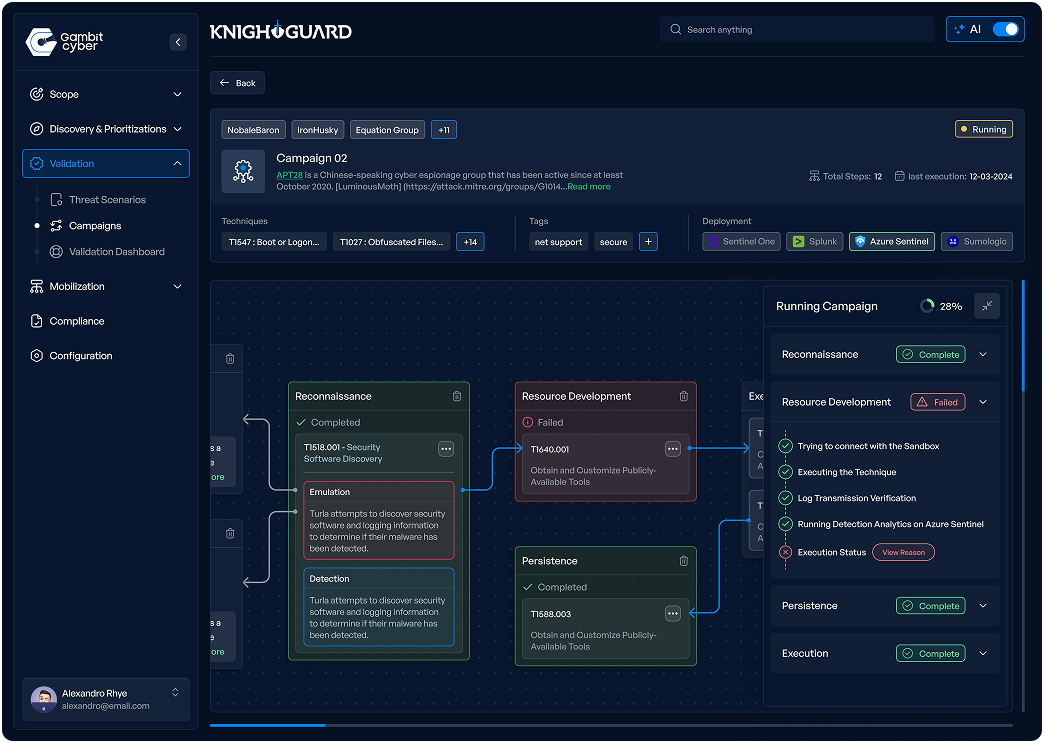
Proves control effectiveness with evidence: collaborative red-and-blue exercises, breach and attack simulation, AI-generated phishing campaigns, threat hunting, and detection engineering — all run against the techniques the Threat Informed Defense module identified as gaps.
Pre-built quantification models for business email compromise, ransomware, data loss, and insider threat, translating technical exposures into likelihood and financial impact. Maps program activity to compliance obligations and produces defensible risk reduction reporting for the board.
These are the workloads the platform ships with. Most programs switch on four or five in the first quarter and grow from there.

Each 30-day phase switches on one module and leaves you with something you can show the board.
We run a unified gap assessment, then stand up Unified Vulnerability Management. Scanners, cloud accounts, and dark web monitoring get connected and de-duplicated, establishing a single source of truth. By day 30 you know what you own, what’s exposed, and which fixes close the most paths.
Threat Informed Defense goes in. Controls get checked against MITRE ATT&CK, your intelligence feeds get folded in, and detection gaps surface against a threat picture specific to your industry. Prioritization now spans vulnerabilities, misconfigurations, threats, and controls together.
Unified Exposure Validation comes online: red-and-blue exercises, simulation campaigns, and proactive hunting. By quarter’s end you have evidence, not assumptions, and a dashboard that shows the movement.
Test whether the exposures you prioritized can actually be exploited — through simulated attacks, phishing tests, collaborative red-and-blue exercises, and proactively searching for signs attackers are already inside. This is the stage most programs skip, and it’s the one that changes the conversation. You stop saying you think you’re secure and start showing that specific controls stopped specific techniques.
Drive remediation, mitigation, or compensating controls across the teams that own them, using bi-directional ITSM integration, AI-generated playbooks, and CISO-ready dashboards that report measurable risk reduction rather than tickets closed. Mobilization fails when security throws findings over the wall to IT. It works when the handover carries context, a playbook, and an owner.

Most organizations begin at Foundation because that’s where the tool sprawl hurts most.
Three consistent shifts, and what they change day to day:
Only a small share of vulnerabilities rated critical typically turn out to be genuinely reachable by an attacker once tested.
In practice: a new CVE drops, and instead of SecOps spending hours manually checking whether it applies, the platform maps it against your actual environment and flags the handful of assets where it’s genuinely exploitable.
A meaningful share of existing security controls are found to be failing through misconfiguration or drift, until continuous testing exposes them.
In practice: instead of assuming the SIEM would catch an exploit attempt, one validation run confirms whether it actually does — and if it doesn’t, the fix is already generated.
Zero-infrastructure deployment gets you to a first view of your exposure fast.
In practice: instead of assuming the SIEM would catch an exploit attempt, one validation run confirms whether it actually does — and if it doesn’t, the fix is already generated.
The measure that matters most is the trend line: quantified financial risk, measured the same way each quarter, going down.

The program produces a continuous, timestamped record of what was tested, what failed, and what was fixed — instead of assembling screenshots the week before an assessment.
Selecting a continuous threat exposure management partner is a long-term decision — here’s what global enterprises weigh most:
CTEM, or continuous threat exposure management, is a five-stage program that continuously scopes, discovers, prioritizes, validates, and mobilizes remediation of an organization’s security exposures, ranked by business risk rather than raw severity. Gartner introduced the framework in 2022.
Scoping, discovery, prioritization, validation, and mobilization. Scoping defines which assets matter to the business. Discovery finds assets, vulnerabilities, and attack paths. Prioritization ranks them by exploitability and business impact. Validation tests whether they’re actually exploitable. Mobilization drives the fix and proves it worked.
Periodic patching is one component of CTEM. It scans known assets on a cycle and ranks them by CVSS. CTEM runs continuously across the full attack surface, ranks by exploitability and business context, and proves through testing whether the exposure is real.
A vulnerability is a technical flaw. An exposure is broader — any condition, including a vulnerability, that gives an attacker a way in, such as leaked credentials or a misconfiguration.
No. The platform is a vendor-agnostic layer that connects to what you already run and unifies the output. For most clients the existing stack stays exactly where it is.
Three places: analyst time saved once teams stop triaging unreachable findings; avoided loss against quantified scenarios like ransomware and BEC; and tool consolidation once overlapping products become redundant.
Yes, though it supports compliance rather than delivering it. It produces dated records of control testing, quantified risk per scenario, and documented remediation — exactly what NIST CSF 2.0 expects to see evidenced, and exactly the kind of coverage mapping MITRE ATT&CK and D3FEND are built to support.