Standard Salesforce covers the basics, but most teams need it to match their own processes. Salesforce Customisation Services adapt layouts, automation, reporting and AI-powered Agentforce agents to how your business runs — making the CRM quicker to use, easier to adopt and ready to scale.
Customise Salesforce and Agentforce AI agents around your business.
Customising Salesforce CRM to align with exact workflows and processes helps teams work smarter, engage customers more effectively and make decisions based on accurate insights. Customisation in Salesforce typically spans page layouts, automation, custom objects, reporting and integrations. Here is what it delivers for a growing business.

Salesforce CRM is adjusted to match internal operations, departments and objectives, so tasks are easier to manage and processes feel natural to the teams using them.

Role-based layouts, automation and dashboards cut clicks and distractions, so teams spend more time on outcomes and less on admin.

Tailored validation rules, required fields, and duplicate controls cut manual errors, so reporting and dashboards across the platform stay trustworthy.

Smart templates, real-time dashboards and integrated tools support personalised customer interactions at every touchpoint.
As the business grows, the CRM adapts with it, supporting expansion into new markets or new functions with confidence.

Tailored Salesforce customisation and configuration solutions move a business beyond standard features and turn CRM spend into measurable return.
Every engagement draws from a full set of configuration and development options, scoped to exactly what a business needs. Configuration covers the everyday build work; custom code handles everything beyond the platform’s limits.
When the standard data model doesn't fit, new objects, relationships and record types give the business its own structure inside Salesforce, built to sound data-modelling practice so reports and automation hold up later.
Each role gets a screen built for its job: the fields it uses, the actions it takes, nothing it doesn't. Dynamic forms and record types keep layouts relevant as a record moves through its lifecycle.
Flows, approval chains and record-triggered logic take over the repetitive steps — routing, updates, follow-ups, sign-offs — so work moves on its own instead of waiting for a manual nudge.
Dashboards built around the numbers a team actually reviews, not the defaults. When the questions get deeper, the same data feeds Salesforce CRM Analytics .
Templates that pull live data from records, quotes, case updates, renewals, so outbound email stays consistent and personal without anyone rekeying details.
Einstein scoring and predictions, Agentforce agents with actions and guardrails set to each team's process, and connections to the finance, marketing and support tools around Salesforce. Salesforce AI solutions build on the same setup.
Profiles, permission sets, sharing rules and field-level access decide who sees what. Getting this right early avoids the messy retrofit that comes with bolting security afterwards.
Legacy data mapped, de-duplicated and loaded through the Bulk API, with checks on both sides so a migration doesn't carry old problems into the new org.
Field and frontline teams get a mobile layout with the quick actions they need on site — not a desktop screen squeezed onto a phone.
Service and sales consoles that put the whole record on one screen, plus AgentExchange packages chosen, installed and configured to fit rather than left on defaults.
Apps inside Salesforce gain tailored logic and screens. For heavier builds, Salesforce development services bring Apex and Lightning Web Components into the mix.
Almost every project needs both, so TechForce Services scopes Salesforce customisation and configuration services as one job — not a config phase billed separately from a code phase.
Configuration is the point-and-click layer: fields, layouts, flows, validation rules. Salesforce configuration services cover a lot of ground at low cost and stay easy to maintain. Code — Apex, Lightning Web Components, integrations — starts where a requirement outgrows that layer. A short discovery session shows which parts fall where, and it usually runs alongside broader Salesforce implementation work.
Salesforce doesn’t stand still. A new team, a new product, a rule change from a regulator — each one is a request for change. Whether that’s handled well over five years usually comes down to who’s holding it: a specialist partner with a plan, or whoever has a spare hour. An advisory review is a low-commitment way to test the roadmap first.
A Salesforce customisation consultant comes back to the org as processes change. In-house admins mean to, then get buried in password resets and report requests, which is where managed services tend to pick up the slack.
Changes go through a sandbox, get tested and get documented — not clicked straight into production on a Friday afternoon. That discipline keeps the next upgrade or security review from turning into an archaeology dig.
Salesforce configuration services, custom development and integration under one team means no gaps between contractors and one place the responsibility sits.
Approval flows, CPQ adjustments, migration scripts — most requirements have been solved before. Reusing that work means Salesforce customisation solutions land faster and behave predictably in production.
TechForce runs this as an ongoing Salesforce customisation service, not a hand-off — as a Salesforce Managed Service Provider, the team that builds it also supports it. Delivery is global, with a local team and support hours in Australia. A typical project moves through six stages.
Customisation applies across the platform, whichever clouds are in play:
Customisation earns its keep where a standard CRM setup leaves gaps:
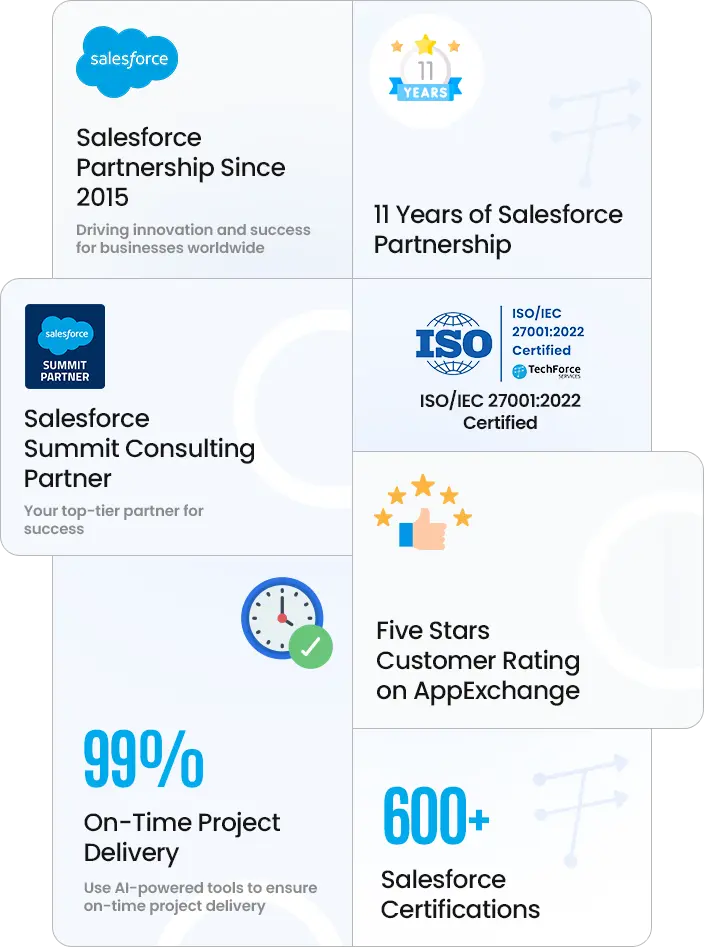
TechForce Services is a specialist Salesforce customisation company that has been doing this for more than a decade. The proof points:
More than a decade and 500+ projects shaping Salesforce for Australian and global organisations.
600+ certifications across multiple clouds and products, plus Summit and Salesforce.org Consulting Partner status. Certified specialists lower delivery risk on every project.
Solutions fit today's need and flex as goals shift, backed by ISO 9001 and ISO/IEC 27001:2022 certification.
From the first strategy session to post-go-live tuning, managed support covers the full journey.
Organisations across Australia and worldwide rely on TechForce Services for dependable, results-driven CRM work, rated 4.9/5 on the AgentExchange.
Sector realities in finance, health, education and professional services are designed in from the start.
Salesforce Customisation Services adapt the platform — objects, page layouts, automation and integrations — to one business, so the CRM matches how the team already works instead of the team adjusting to the software.
Configuration is the no-code layer: fields, page layouts, flows and validation rules. Customisation adds Apex, Lightning Web Components and integrations for anything that can’t be built with clicks. Most Salesforce projects use both, scoped together rather than billed as separate phases.
It depends on how many processes are involved, how much data moves and how much custom code is needed. As a general industry guide, small configuration work runs into the low thousands and multi-system builds go well beyond that. TechForce sets a fixed figure after a discovery session, before any build starts.
A single, well-defined change is usually one to two weeks. A programme across several teams runs one to three months, released in stages so the first improvements land early.
Yes. Finance, ERP, marketing and support systems connect through APIs or middleware, keeping records consistent across every tool the business runs.
The client. Standard practice, and what to expect from any Salesforce customisation consultant, is full handover of custom code, configuration and documentation, with IP terms agreed before work begins.
Yes. As a Salesforce Managed Service Provider, TechForce keeps refining the build as processes change; managed services cover the ongoing work.
Any sector where a standard setup leaves gaps — financial services, healthcare, retail, education, professional services and government, especially where compliance rules or multi-team workflows are involved.