


With ample justification, Salesforce has earned its status as the world’s most renowned CRM system. Its robust feature set caters seamlessly to organizations of diverse backgrounds and sizes, establishing it as an ideal sales solution. Beyond its sales prowess, Salesforce empowers users with effortless access to crucial operational data, enabling informed decision-making of the highest caliber. Moreover, this powerful platform extends its reach through a range of 15 Salesforce Cloud Services, catering to specific industry needs.
In this article, we delve into the Salesforce clouds list services and explore how these Salesforce clouds serve various industry types with unparalleled efficacy.
What is a Salesforce Cloud?
A Salesforce Cloud refers to a specific set of cloud-based services offered by Salesforce, a leading customer relationship management (CRM) platform. These cloud services are designed to address various business needs and provide specialized functionalities to organizations. Each Salesforce Cloud is tailored to specific areas of business operations, such as sales, marketing, service, and more, with the aim of enhancing productivity, streamlining processes, and improving customer relationships.
Salesforce Clouds are built on a shared infrastructure and offer a range of features and tools that enable businesses to manage and automate their core functions. These cloud services typically include data storage, collaboration capabilities, reporting and analytics, customization options, and integrations with other systems.
Types of Salesforce Clouds and Their Features
If you’re not familiar with Salesforce, you might assume that it only provides one product for managing customer relationships (CRM). However, in reality, Salesforce offers a diverse range of services and tools, each designed for specific functions or markets. These tools are referred to as “clouds” because they are delivered through cloud computing. While there are six main types of Salesforce clouds, the platform actually has a total of 15 different clouds in Salesforce to cater to various business needs.
Are you looking for Salesforce Cloud Services?
6 Major Types of Clouds in Salesforce
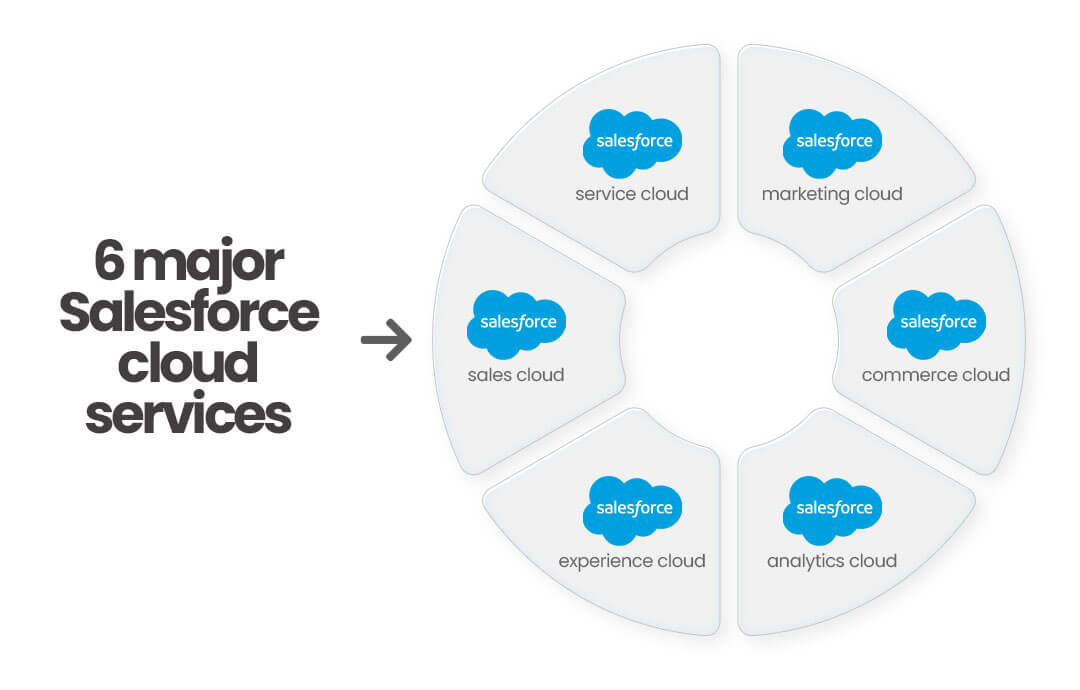
Most companies commonly utilize six major salesforce cloud types, alongside a range of more specialized clouds. The six major clouds are as follows:
1. Salesforce Sales Cloud
Salesforce Sales Cloud is a powerful cloud-based solution designed to streamline the sales process and optimize customer relationship management. It offers a wide range of features that empower sales teams to effectively manage leads, close deals, and drive revenue. Here are some key features of Salesforce Sales Cloud:
- Account and Contact Management: Organize and track customer interactions.
- Lead Management and Tracking: Capture, assign, and update leads throughout the sales pipeline.
- Opportunity and Product Management: Manage sales opportunities, forecast revenue, and handle products/pricing.
- Campaign Management: Plan, execute, and track marketing campaigns for effective targeting.
- Sales Analytics and Reports: Gain insights into sales performance, pipeline visibility, and rep productivity.
- Sales Collaboration: Foster team collaboration, information sharing, and deal updates.
- Mobile Sales: Access customer info, track activities, and manage deals on-the-go.
- Integration Capabilities: Seamlessly integrate with other Salesforce clouds and third-party apps.
2. Salesforce Marketing Cloud
Salesforce Marketing Cloud is an all-inclusive digital marketing platform that empowers businesses to create, automate, and personalize marketing campaigns across various channels, ensuring impactful and targeted customer engagements. It offers a range of features to effectively manage and optimize marketing efforts. Below are several notable features offered by Salesforce Marketing Cloud:
- Email Marketing: Create personalized email campaigns, segment audiences, and track performance.
- Social Media Marketing: Engage on social media, schedule posts, monitor conversations, and analyze campaign performance.
- Mobile Marketing: Execute mobile campaigns, including SMS and push notifications.
- Journey Builder: Automate customer journeys based on behavior and preferences.
- Personalization and Segmentation: Tailor messages and create segments based on demographics and behavior.
- Advertising Studio: Manage digital campaigns across multiple channels.
- Data and Analytics: Gather customer data, track performance, and gain insights.
- Social Listening and Monitoring: Monitor social media for brand mentions and competitor insights.
- Content Management: Store and manage marketing assets in a centralized library.
- Marketing Automation: Automate processes, including lead nurturing and personalized content delivery.
Related Read: A Guide to Salesforce Marketing Cloud Implementations
3. Salesforce Experience Cloud
Salesforce Experience Cloud, formerly known as Salesforce Community Cloud, is a platform that allows businesses to create branded and personalized online experiences for their customers, partners, and employees. It enables organizations to build self-service portals, online communities, and other digital experiences to engage and connect with their stakeholders. Here are some key features of Salesforce Experience Cloud:
- Branded Portals: Create visually appealing portals aligned with your organization’s identity.
- Personalized Content: Deliver tailored content based on user preferences.
- Community Engagement: Foster collaboration, knowledge sharing, and discussions.
- Self-Service Capabilities: Empower users to find information and resolve issues independently.
- Partner Relationship Management: Provide a dedicated space for partner collaboration.
- Knowledge Base: Build a comprehensive self-help resource with articles and FAQs.
- Case Management: Enable users to submit and track support cases.
- Brand Collaboration: Extend community to external stakeholders for streamlined collaboration.
- Mobile Accessibility: Access the community on mobile devices for seamless engagement.
- Integration Capabilities: Integrate with other Salesforce clouds and third-party systems.
4. Salesforce Service Cloud
Salesforce Service Cloud is a comprehensive platform designed to provide outstanding customer service and support, empowering businesses to deliver exceptional customer experiences. It provides a comprehensive set of features to streamline service operations, enhance agent productivity, and improve customer satisfaction. Here are some key features of Salesforce Service Cloud:
- Case Management: Efficiently handle customer inquiries and support requests through a centralized system.
- Omnichannel Support: Engage with customers across multiple channels for a seamless experience.
- Knowledge Base: Empower customers with self-service options and assist agents with accurate information.
- Live Chat and Chatbots: Provide real-time chat support and leverage AI-powered chatbots.
- Service Console: Unify customer information, collaborate, and resolve issues efficiently.
- Service Analytics and Reports: Gain insights into service performance and customer satisfaction.
- Case Routing and Assignment: Automate case routing to suitable agents for efficient handling.
- Service-Level Agreements (SLAs): Prioritize and meet customer expectations with defined response times.
- Field Service Management: Optimize field service operations with scheduling and real-time updates.
- Integration Capabilities: Seamlessly integrate with other Salesforce clouds and third-party applications.
5. Salesforce Commerce Cloud
Salesforce Commerce Cloud, formerly known as Demandware, is a cloud-based e-commerce platform that helps businesses deliver personalized and seamless shopping experiences across various channels. Below are some key features of Salesforce Commerce Cloud:
- Online Storefront: Build and manage customizable online storefronts with product catalogs and pricing options.
- Personalization: Deliver personalized shopping experiences based on customer data and preferences.
- Omnichannel Commerce: Enable seamless shopping across web, mobile, social media, and physical stores.
- Order Management: Streamline order processing, inventory, and fulfillment across locations and channels.
- Mobile Commerce: Optimize mobile shopping with responsive design and app integration.
- AI-Powered Recommendations: Analyze customer behavior to provide intelligent product recommendations.
- Marketing and Promotions: Run targeted campaigns, discounts, and promotions to drive sales and loyalty.
- Content Management: Publish engaging content for compelling online experiences.
- Customer Service Integration: Integrate support capabilities for order status and real-time assistance.
- Analytics and Reporting: Gain insights into customer behavior, sales, and marketing effectiveness.
- Scalability and Security: Ensure a scalable and secure infrastructure for high traffic and data protection.
6. Salesforce Analytics Cloud
Salesforce Analytics Cloud, also known as Einstein Analytics, offers powerful data analytics and visualization capabilities. Its features include:
- Data Exploration: Uncover insights and patterns by exploring your data interactively.
- Dashboard Creation: Visualize data and track key metrics in real time with customizable dashboards.
- Advanced Analytics: Utilize predictive modeling and machine learning to uncover trends and make data-driven predictions.
- Data Integration: Connect and integrate data from multiple sources for a comprehensive view of your business.
- Mobile Analytics: Access analytics on the go through mobile-friendly dashboards and reports.
- Collaboration and Sharing: Share dashboards, collaborate with team members, and facilitate data-driven decision-making.
- Embedded Analytics: Access insights directly within Salesforce applications and workflows.
- Natural Language Processing: Ask questions in plain language and receive instant answers and visualizations.
- Data Security and Governance: Ensure data security and compliance with robust measures and governance controls.
- AppExchange Integration: Extend capabilities with pre-built analytics applications and solutions from the Salesforce AppExchange marketplace.
Are you looking for Salesforce Cloud Services?
The 9 Other Salesforce Cloud Services are:
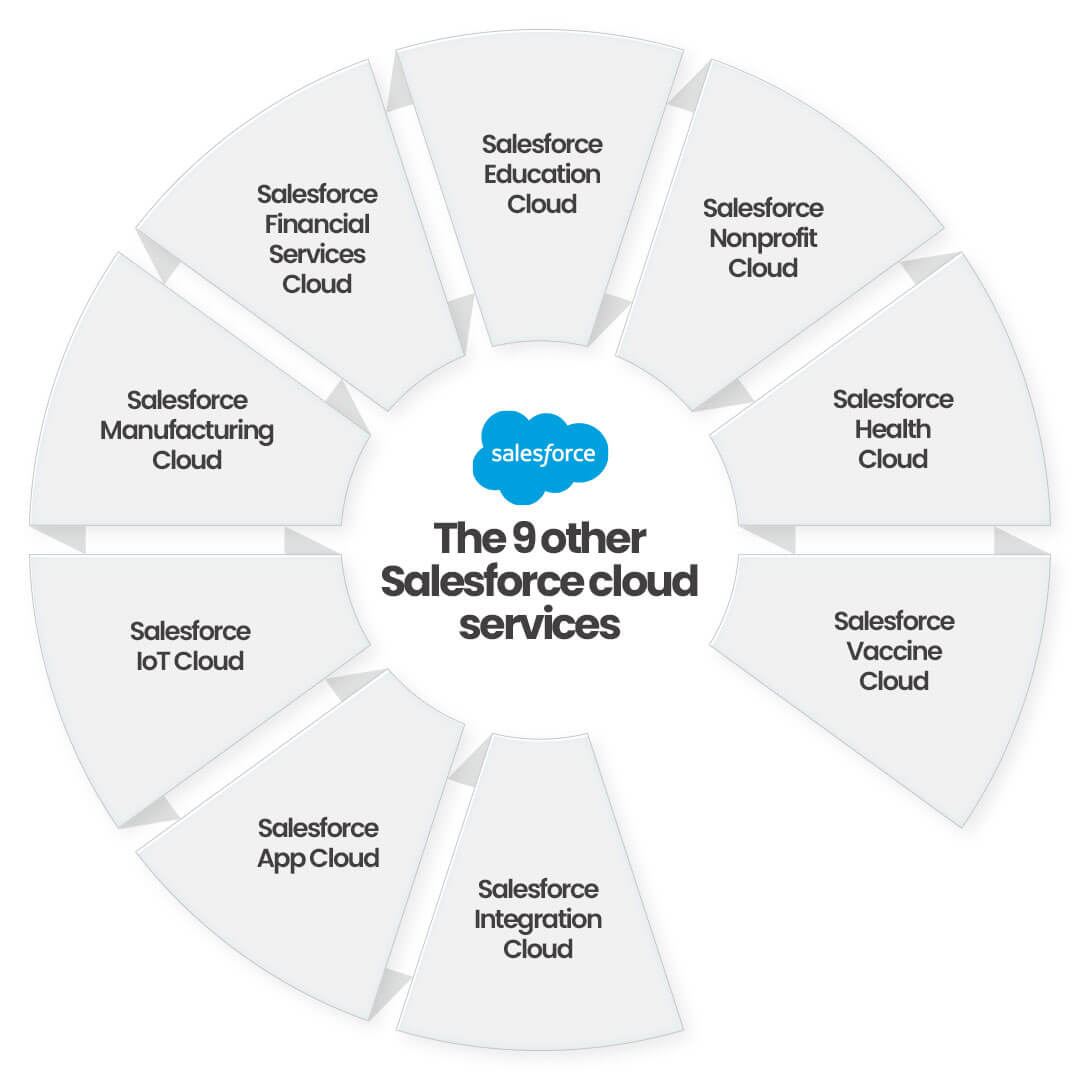
7. Salesforce Integration Cloud
Salesforce Integration Cloud is a cloud-based platform that allows for seamless connections between Salesforce and other business applications. It offers pre-built connectors for popular applications like SAP, Oracle, and Microsoft Dynamics, and a user-friendly interface for creating custom integrations. With Salesforce Integration Cloud, data synchronization, process automation, and integration building become effortless without coding.
8. Salesforce App Cloud
Salesforce App Cloud is a cloud-based development platform designed for building applications on the Force.com platform. It provides a comprehensive set of tools and services for developing, deploying, and managing applications. The platform also includes features specifically tailored for social, mobile, and cloud-based applications.
9. Salesforce IoT Cloud
Salesforce IoT Cloud is a cloud-based platform that enables businesses to connect and leverage their devices and sensors. It allows for real-time insights and application development using data from a variety of devices, including third-party devices.
10. Salesforce Manufacturing Cloud
Salesforce Manufacturing Cloud is a service aimed at helping manufacturers efficiently manage production processes and supply chains. It offers a complete view of the manufacturing lifecycle, from raw materials to finished products, enabling optimization of operations and improvement of overall performance.
11. Salesforce Financial Services Cloud
Salesforce Financial Services Cloud is a cloud-based solution that provides secure connectivity for financial service organizations with their customers, partners, and employees. It serves as a unified platform for managing customer data, applications, and processes in the financial sector.
Related Read: A Guide to Salesforce Financial Cloud
12. Salesforce Education Cloud
Salesforce Education Cloud is a cloud-based solution designed for educational institutions to effectively manage their data and operations. It offers a centralized platform for student data management, progress tracking, and stakeholder communication. Additionally, it provides customizable features and tools to meet the unique needs of each institution.
13. Salesforce Nonprofit Cloud
Salesforce Nonprofit Cloud is a cloud-based software as a service (SaaS) offering that equips nonprofits with a comprehensive set of tools to manage their organizations. It includes features for donor management, fundraising, program management, and constituent engagement. The Nonprofit Cloud is built on the Salesforce1 Platform, allowing customization to meet specific requirements.
14. Salesforce Health Cloud
Salesforce Health Cloud is a cloud-based solution that assists organizations in managing patient data and improving care coordination. It includes a care management system, patient portal, mobile app, and integration capabilities with third-party applications and electronic health records (EHRs).
15. Salesforce Vaccine Cloud
Salesforce Vaccine Cloud is a cloud-based vaccine management system that aids organizations in tracking immunization records and inventory. It features a web-based interface and mobile app for vaccination tracking, along with functionalities for distribution and administration management. The Salesforce Vaccine Cloud is secure, reliable, and scalable, adaptable to the needs of any organization.
Conclusion
Implementing and managing all the different Salesforce clouds can feel overwhelming. That’s where the TechForce services team of Salesforce experts comes in. We specialize in helping businesses choose and manage the specific Salesforce clouds that are perfect for their needs. With our years of experience in Salesforce installations, we have the knowledge and expertise to guide you in finding the right solutions for your business. Our Salesforce Consulting Services will ensure that you get the maximum value from your Salesforce clouds and help your business thrive and grow.